Session Summary
Last session began with a ghostly plea. As you slept at the Blue Water Inn, a spirit calling itself “Erasmus” manifested in your room—frost creeping across windows, objects levitating—and wrote a desperate message: “Help Victor.” The ghost of a boy reaching from beyond death, asking you to aid the Baron’s reclusive son.
But first, you had a promise to keep. With Arabelle’s gift in hand—a disturbingly cheerful carousel of wolves chasing children, courtesy of Blinsky’s macabre imagination—you journeyed to the Vistani Camp. There you found not celebration, but tragedy. Luvash, Arabelle’s father, stood grief-stricken and wounded, his rage barely contained as he confronted Alexei, the cousin who’d failed to protect her. Two days ago, Arabelle had vanished. A Vistani named Yan was found decapitated near the Luna River. And a mysterious platinum ring bearing arcane symbols had been dropped at the scene.
You descended into the dusk elf hovels to meet Kasimir Velikov, keeper of the ring and leader of a dying people. Arden healed the frostbite on Kasimir’s hand, and in gratitude, the ancient elf shared his tale—five centuries of sorrow. He spoke of Othrondil, the Forest of Twilight, where dusk elves once lived free. Of his uncle Erevan Löwenhart, who bore the lion’s sigil and refused to bow to King Barov. Of Rahadin, Kasimir’s own cousin, who betrayed their people and shattered Erevan’s blade. Of Strahd’s genocide that left fewer than a hundred survivors trapped in this valley for half a millennium.
Then Arden revealed the Broken Blade—bearing Erevan’s lion sigil, impossibly returned after centuries. Kasimir embraced him as kin, and together they swore an oath: that blade would taste vengeance. Rahadin and Strahd would answer for their crimes.
You investigated the crime scene at the Luna River, fighting through an ambush of twig blights and scarecrows at the crossroads. At the clearing where Yan died, Fig’s keen investigation revealed the truth: three sets of footprints told a story of betrayal and abduction. Someone fought Yan here. Someone else fled into the trees. And a third individual—carrying something child-sized—waded into the river. High in the branches, you found torn silk fabric radiating undead energy. The evidence pointed to Escher, Strahd’s elegant and most recent vampire spawn.
At the Vallakovich Manor library, you made another disturbing discovery. While researching the mysterious ring, Fig found genealogical records showing that eighteen years ago, an “Ireena Strazni” died of unknown causes—survived by her brother Izek Strazni and parents who subsequently hanged themselves. The same Izek who now serves as the Baron’s enforcer. The same Izek who commissions dolls that look exactly like Ireena Kolyana. Coincidence seemed impossible in a land where nothing happens by chance.
Victor Vallakovich interrupted your research, and an unexpected alliance formed. Bonding over shared contempt for his father’s foolish festivals, Victor revealed crucial information: the ring bore Khazan’s sigil. Khazan, an archmage who built a tower on Lake Baratok protected by anti-magic enchantments. When you mentioned Erasmus’s ghostly plea, Victor’s expression shifted from defensiveness to resignation. He led you to his attic workroom.
There, among arcane diagrams and a skeletal cat named Patches, Victor showed you the mirror. And in that mirror appeared Stella Wachter—not her body, but her soul, trapped and fading in the Ethereal Plane. Two months ago, Victor and Stella had attempted to build a teleportation circle to escape Barovia. The experiment failed catastrophically, severing Stella’s soul from her body. Only Erasmus’s intervention had kept her alive this long, but she was dissolving. Perhaps a week remained.
Victor had found a solution: a ritual from Khazan’s books that could transport you into the Ethereal Plane to reverse the damage and return Stella’s soul to her body. The catch? It required a night hag’s heartstone. And Erasmus had spotted just such a creature haunting the Refugee Camp—almost certainly Morgantha, the old woman selling dream pastries. You had five days until the full moon to obtain the heartstone and perform the rescue.
As twilight fell, you arrived at Wachterhaus for dinner with Lady Fiona Wachter, carrying the weight of impossible secrets. Her daughter’s soul was trapped in a mirror miles away in Victor’s workroom. Her daughter’s body wandered the halls, empty and catatonic. In the parlor, you witnessed Stella’s vacant form firsthand before Nikolai led her away for a garden walk. Then Lady Fiona herself entered—striking, composed, radiating controlled dignity—and welcomed you with reserved warmth.
“Now then,” she said, settling into her chair with a glass of brandy and appraising eyes, “shall we get acquainted?”
And there, surrounded by secrets and lies, with a missing Vistani girl in a vampire’s clutches, a fading soul counting down her final hours, a broken blade sworn to vengeance, and a mysterious death record connecting Ireena to the Baron’s monstrous enforcer, your evening’s conversation began.
A Breakfast of Borscht
The pre-dawn mists hung thick over Vallaki as Arden rose early from his bed at the Blue Water Inn. Restless energy pushed him out into the cool morning air, his boots crunching softly against the cobblestones as he wandered the still-sleeping streets. Near the eastern gate, he encountered Szoldar Szoldarovich and Yevgeni Krushkin—the wolf hunters—already awake and preparing for a day’s work in the wilderness. The grizzled hunters exchanged nods with the paladin as they hefted their crossbows and headed out to check their traplines, disappearing into the gray fog beyond the town walls.
Back at the inn, the others stirred from sleep—only to be jolted fully awake by an unnatural chill that swept through their room. One of the windows slammed open with a bang, admitting a frigid draft that set their breath misting in the suddenly cold air. Frost crept across the glass panes like reaching fingers, and the party watched in mounting alarm as their belongings began to levitate, hovering inches above tables and bedframes. The window shutters rattled violently in their frames.
Then, slowly and deliberately, an invisible finger began inscribing letters in the frost: Help Victor.
The words hung there for a heartbeat, then the unseen hand added—almost hesitantly—Please.
The presence felt desperate yet innocent, shining with fierce determination. This was Erasmus, reaching out from beyond death itself to seek aid for someone still among the living.
Over breakfast in the taproom—hot bowls of borscht and fresh bread—the party recounted the supernatural visitation to Urwin. The innkeeper listened thoughtfully, his expression grave. “Victor?” he mused, scratching his beard. “That would be Victor Vallakovich, the Baron’s son. A strange lad—keeps to himself, doesn’t come down from the mansion much. If spirits are seeking help for him…” He shook his head, leaving the implications unspoken.
The group exchanged glances, adding this mystery to their growing list of concerns. And then there was still Rictavio—the flamboyant bard whose too-convenient arrival and oddly well-stocked carnival wagon continued to raise suspicions. But with a missing Vistani girl to find and a dinner invitation from Lady Wachter looming that evening, investigating Rictavio would have to wait.
Visiting the Vistani
With Arabelle’s gift secured—a wind-up carousel with wolves chasing children, courtesy of Blinsky’s macabre imagination—the party set out westward along the Old Svalich Road. The morning fog clung stubbornly to the ground as they followed the directions they’d been given, eventually turning south onto a narrow wooded path that wound through stands of ancient trees.
The woods parted suddenly, revealing an expansive clearing: a small, grass-covered hill crowned with a ring of barrel-topped wagons surrounding a large tent. Smoke poured from a hole in the tent’s peak, and even from a distance, the mingled smells of wine and horses carried on the still air. Built into the hillside below were low houses featuring elegantly carved woodwork and decorative lanterns hanging from sculpted eaves. This was the Vistani Camp, home to Luvash’s traveling family and refuge for the last remnants of the dusk elves.
As they approached, a dusk elf guard stepped forward to intercept them. Savid, he called himself—a man with the dusky skin and violet eyes characteristic of his people. When the party explained they carried a gift for a Vistani girl, Savid’s expression darkened. He winced and gave them a grim smirk that held no humor whatsoever. “You’ll want to speak with Luvash,” he said, pointing up the hill toward the large central tent. “He’s… not in the best of moods.” The guard’s tone suggested that was a significant understatement.
Climbing the hill, the party ducked through the tent’s entrance and immediately heard the sound of splintering wood and shattering ceramic. The interior was hazy with campfire smoke, lit by three sputtering fires burning low with embers. Six Vistani sat around the hearths, watching the source of the commotion with solemn, sympathetic expressions.
At the center of the tent, a shirtless young man knelt on the dead grass, his face pale and eyes downcast. Beside him lay a broken wooden crate amidst scattered pottery shards, still wobbling from the force of impact. This had to be Alexei, Arabelle’s cousin—the one who’d failed to keep her safe.
A dozen feet away stood a larger, older man in studded leather armor, his thick beard well-trimmed but his eyes bloodshot and trembling. He leaned heavily against a makeshift wooden crutch; his lower right leg was wrapped in blood-stained bandages. “You were supposed to keep her safe!” the man bellowed hoarsely, his voice raw with grief and rage. He whirled, reaching blindly for something else to throw. Sweat beaded on his forehead as he choked back a sob. “My little girl! And now—”
He wavered, stumbling—and in a blink, a third man stepped from the shadows and caught him on his shoulder before he could fall. This newcomer also wore studded leather and sported a fine-trimmed goatee. “Easy, brother,” he murmured, his voice calm and measured. “You’ve lost a lot of blood.” His sharp eyes flicked to the party, his brow tightening almost imperceptibly. “And it would appear that we have company.”
This was Luvash and Arrigal—the leaders of this Vistani family. Luvash, the gruff, hot-tempered father driven to near-madness by his daughter’s disappearance. Arrigal, his brother-in-law and adviser, the more cautious and calculating of the two.
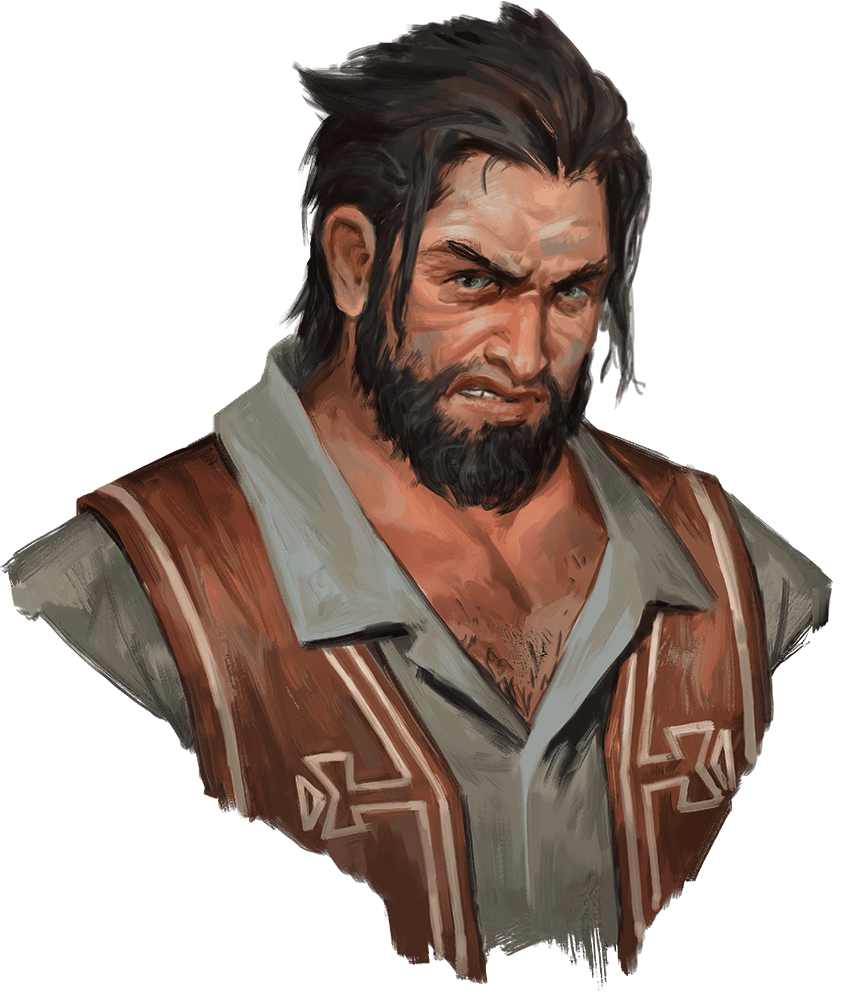 LUVASH
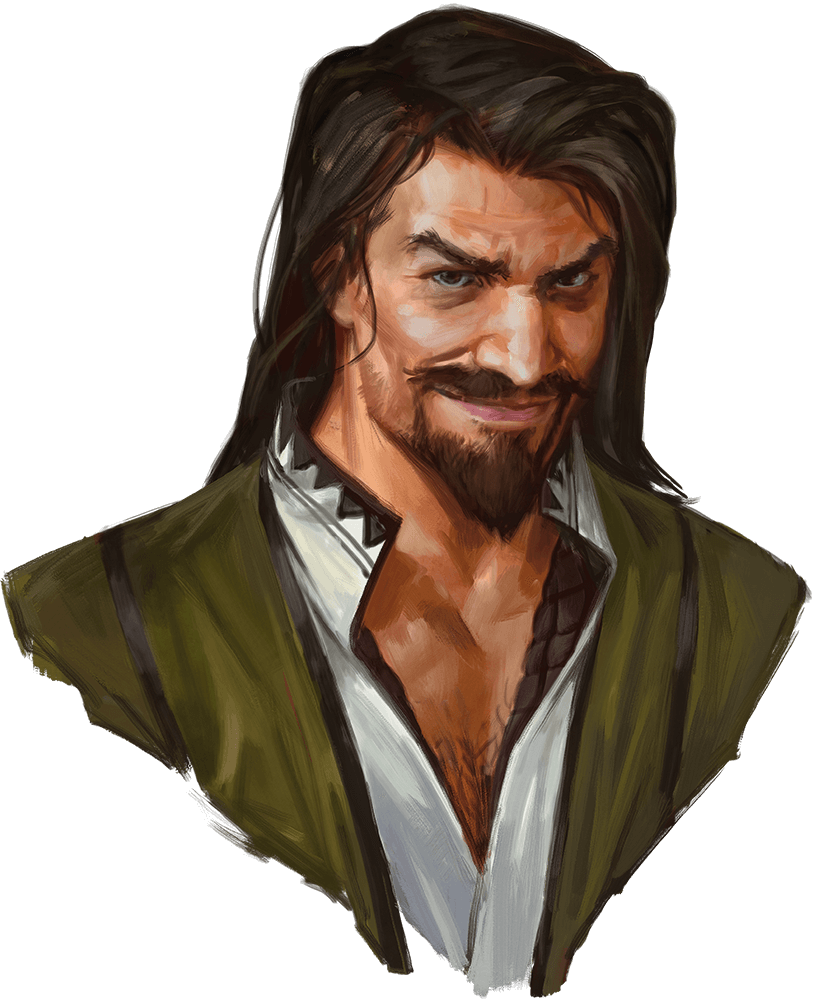 ARRIGAL
The party stepped forward carefully, introducing themselves and explaining their purpose. At the mention of help, Luvash’s demeanor shifted—desperation replacing anger as he grasped at any hope of finding Arabelle. He waved away Alexei with disgust and gestured for the party to join him by one of the fires.
The story tumbled out in fragments, Luvash’s composure cracking with every detail: His daughter had vanished three days ago while under Alexei’s watch. The fool had gotten drunk on wine—wine provided by Yan, a long-time member of the encampment who had mysteriously vanished when Alexei woke. When they went searching, a dusk elf named Savid discovered Yan’s decapitated body near the Luna River, signs of a violent struggle evident in the disturbed earth and trampled grass.
But there was a clue—a strange platinum signet ring found in the grass near Yan’s body, dropped during the struggle. “The ring may lead to my daughter’s location,” Luvash said, his voice heavy with desperate hope. He’d given the ring to Kasimir Velikov, the leader of the dusk elves, to identify. “Kasimir knows things—old magic, symbols, history. If anyone can tell us what that ring means, it’s him.”
Arrigal leaned forward, his curiosity evident as he studied the party. “We would ask that you retrieve the ring from Kasimir,” he said smoothly, “and research it in Baron Vallakovich’s library. The Baron has the finest collection of books in Vallaki—surely something there will reveal the ring’s significance.”
Luvash promised a reward of 500 gold pieces—or treasure of equal worth—if they could bring Arabelle home safely. Then he told them where to find the presumed site of the abduction: a clearing near the Luna River, west along the road and then south. “You’ll know it when you see it,” he said grimly. “Yan’s body is still there.”
The party agreed without hesitation, and Luvash’s shoulders sagged with relief—the first crack in his armor of rage since they’d arrived.
Tea with Kasimir
Following Arrigal’s directions, the party descended the hill and made their way to one of the low houses built into the hillside—a modest hovel marked by hanging sketches and portraits visible through its windows. They knocked, and a quiet voice bade them enter.
Inside, they found unexpected warmth. The small vestibule was several degrees warmer than the chill mists outside, its walls decorated with portraits of proud, wise-looking elves with dark skin, tree-borne spires carved of dark wood, and artistic depictions of constellations and celestial bodies. Dark brown curtains obscured the entrance to an inner chamber, from which flickered the dancing light of a fireplace.
Pushing through the curtains, they entered a comfortable room heated by the fire at its north end. An old green rug sat before the hearth beside a wooden table flanked by several chairs. Cubbyholes along one wall held leather-bound books and small wooden statuettes of elven figures, while a faded tapestry on the opposite wall depicted a lush and beautiful forest beneath a noonday sun—a vision of a world that perhaps no longer existed.
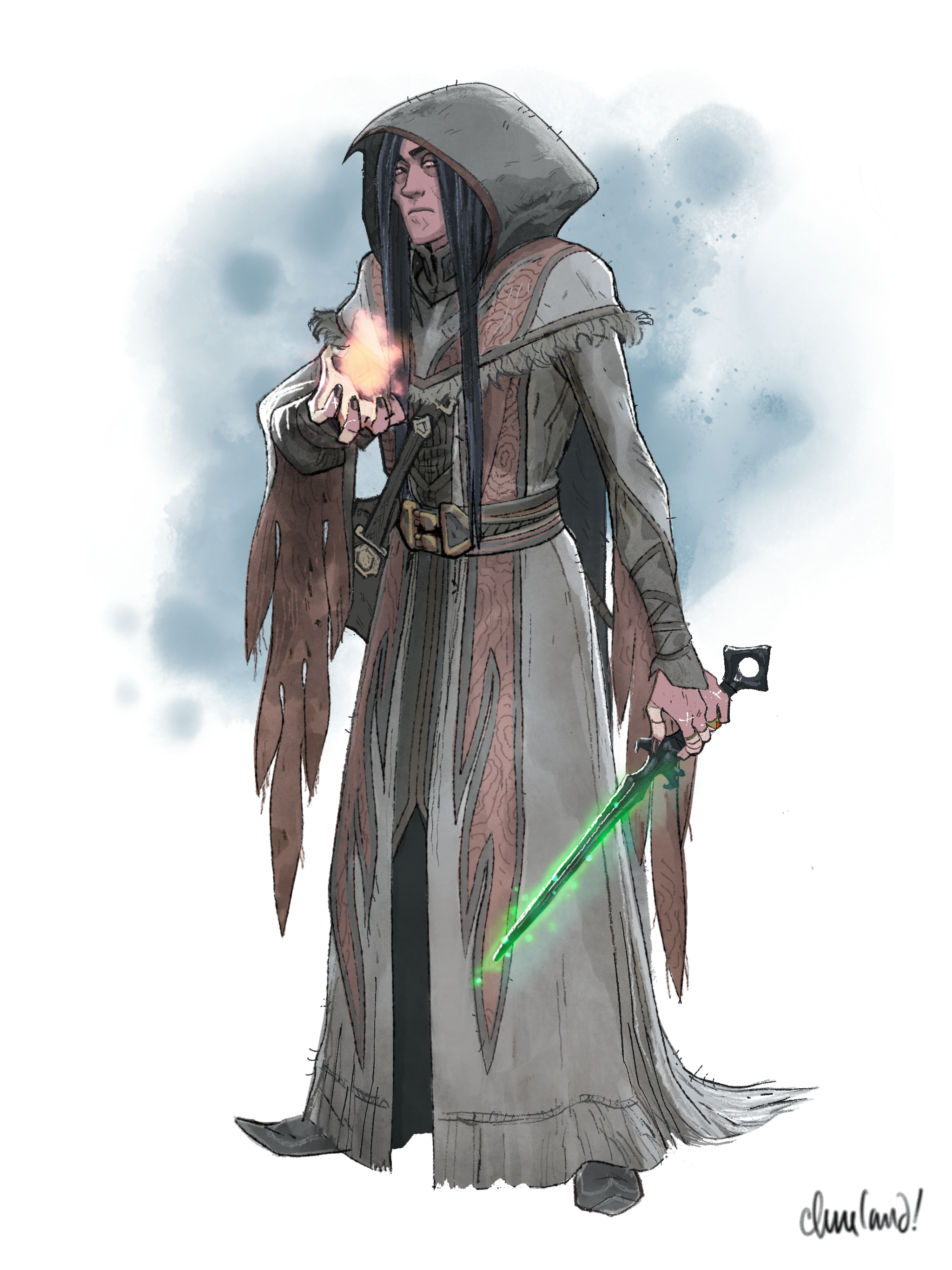 KASIMIR VELIKOV
Sitting on the green rug facing the fire was Kasimir Velikov. He was thin in the way of men who have survived history rather than lived through it. His dusky skin was drawn tight over sharp cheekbones, and his long dark hair—streaked with silver—hung loose past his shoulders. His violet eyes were alert but hollow, fixed on something beyond immediate perception, as if listening to echoes from a distant past. Most striking was his right hand and forearm: pale bluish-white, the skin puffy and blistered with frostbite.
Kasimir turned at their entrance, and Arden—moved by compassion and recognizing a fellow warrior bearing old wounds—stepped forward immediately. Golden light suffused the paladin’s hands as he invoked his divine gift, placing them gently on Kasimir’s injured arm. The dusk elf watched with curiosity as the blisters faded, color returning to the frost-damaged flesh. He flexed his fingers experimentally, then nodded his thanks with the ghost of a smile.
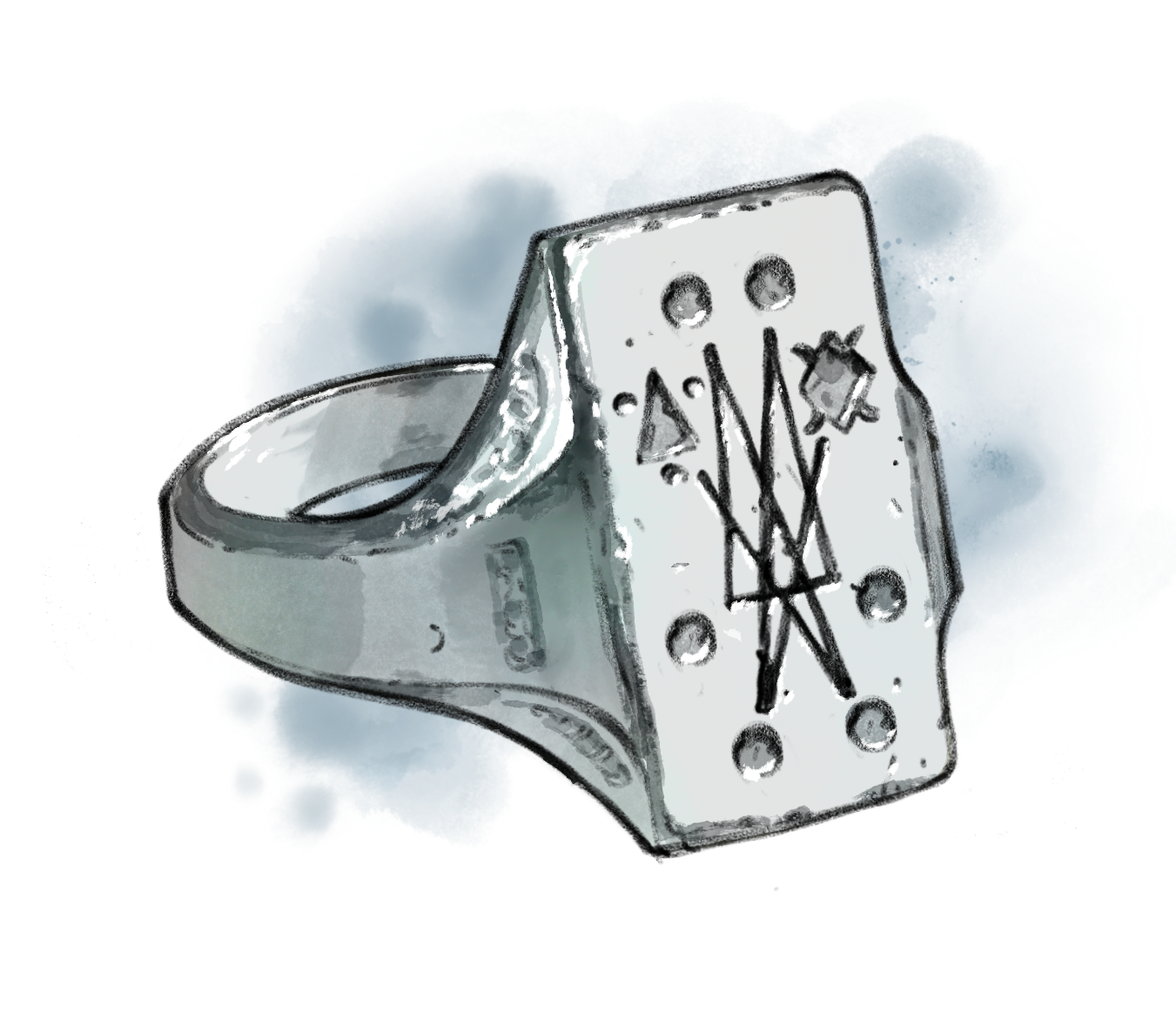 THE SIGNET RING
When asked about the platinum ring, Kasimir produced it from a pocket and held it up to the firelight. The sigil etched into its face gleamed: two intertwined symbols representing schools of magic. “Necromancy and evocation,” Kasimir identified, his voice carrying the certainty of scholarly knowledge. “But as for whose sigil this is, or what purpose it serves? That, I cannot say. The Baron’s library may hold answers—it’s said to be quite extensive.”
But Arden’s attention had shifted. The paladin was staring at Kasimir with barely concealed wonder. “Forgive me,” Arden said, “but I’ve never met elves like you before. Your people—you’re dusk elves? Where do you come from? What’s your history?”
Interest flickered in Kasimir’s hollow eyes—perhaps the first genuine spark they’d held in some time. He gestured to the chairs around the table and put a kettle on to boil. “That,” he said, “is a long story. And not a happy one.”
As tea steeped and the fire crackled, Kasimir told them his tale. His voice remained measured and controlled, but centuries of sorrow lay beneath every word:
“Even now, nearly five centuries past, the memories are sharp and clear in my mind, like shards of broken glass. I was a mere century old when my people lost their freedom—when the tyranny of the von Zarovich clan rose like a shadow across the land.”
He spoke of Othrondil, the Forest of Twilight, where the dusk elves once dwelled in freedom under a council of princes. He described Erevan Löwenhart, his uncle—a master of bladesong who bore the lion’s sigil and refused to bow to King Barov von Zarovich II. He recounted the war that followed, swift and brutal, led by Barov’s forces joined by Rahadin—Kasimir’s own cousin, a traitor to their people. Kasimir had been a mage and scribe in Erevan’s court, and he’d watched Rahadin shatter Erevan’s blade and execute the royal family, marking the end of the royal line.
When Barov died and Strahd came to power, the dusk elves rose in rebellion—only to be crushed in days. Strahd’s genocide left fewer than a hundred alive. The survivors found sanctuary with the Vistani, who led them here, to this valley. But within a year, Strahd had conquered the valley itself and named it Barovia, trapping them within their conqueror’s empire. And here they had remained for nearly five centuries, a dying people with no future.
As the story ended, silence fell over the room, heavy with the weight of lost kingdoms and shattered hopes. Then Arden reached into his pack and withdrew something wrapped in cloth: the Broken Blade that had appeared among his possessions days earlier, its origin a mystery.
He unwrapped it carefully and held it out. The broken blade caught the firelight, its edge still keen despite the shattered tang. Etched into the metal near the break was a sigil—the same lion’s sigil Kasimir had just described.
Kasimir’s breath caught. His hands trembled as he reached out, not quite touching the blade, his eyes filling with something between disbelief and wonder. “Erevan’s blade,” he whispered. “The blade Rahadin shattered. How…?”
“I don’t know,” Arden admitted. “It simply appeared. But if this blade chose to find me—if it came to me for a purpose—then perhaps that purpose is justice. Vengeance for your people.”
Kasimir looked up at the paladin, and for the first time since they’d met, life blazed in those hollow eyes. He stood, and without a word, embraced Arden as kin. When they parted, both were resolved. “Then we swear it here,” Kasimir said, his voice steady and sure. “That blade will taste the blood of those who destroyed my people. Rahadin will answer for his crimes. And Strahd himself will fall.”
It was an oath that would echo through the months to come.
CSI: Luna River
Before returning to Vallaki, the party—joined by Ireena, who had insisted on accompanying them—set out westward to investigate the site of Arabelle’s disappearance. The road narrowed as it wound between dense, towering trees, their branches forming a canopy that filtered the perpetual gray light into something even dimmer. Eventually, they came upon an old wooden bridge spanning the rushing waters of the Luna River, its age-worn planks groaning under their weight.
Halfway across, Fig spotted something odd: a small scrap of white material fluttering on the river’s surface downstream, caught on a tree root. The rogue retrieved it—a handkerchief monogrammed with the initials “R.V.R.” A clue, perhaps, though its significance escaped them for now.
Continuing south, they reached the Luna River Crossroads where the road split into an X-shaped intersection. Scattered across the crossroads stood four small dead saplings, their branches and trunks blackened and gnarled. Nearby, a pair of scarecrows hung mounted on twisted, low-hanging tree branches, their painted sackcloth eyes seeming to watch with mocking intensity. Black raven feathers poked from their stuffed guts. The lower half of a snapped wooden signpost thrust upward at an angle, its top half lying broken in the weeds.
The ambush came without warning.
The saplings jerked to life, revealed as twig blights that scuttled forward on root-like appendages, their branch-arms whipping toward the party. The scarecrows tore themselves from their moorings with inhuman strength, straw bodies moving with unnatural coordination. Choppy’s magic flared, Varnish’s blade sang, and Arden’s greatsword cleaved through twisted wood. The skirmish was brief but intense—these were creatures of dark magic, animated by Barovia’s corruption. Within moments, the blights lay shattered and the scarecrows torn apart, nothing but kindling and scattered straw.
As the party caught their breath, Ireena spoke quietly, her eyes on the destroyed plant creatures. “The Forest Folk,” she said. “The original inhabitants of this valley, from before it was called Barovia. They worship Strahd as a god. Their ways are… mysterious. Frightening, even to those of us who grew up here. They’re said to gather at Yester Hill.” She glanced at the party, her expression troubled. “I don’t know if these creatures are their work, but the timing feels too deliberate to be coincidence.”
The party pressed on to the riverside clearing Luvash had described. There, in the trampled grass, they found Yan’s headless corpse, already beginning to decay. The smell was unpleasant, but they’d smelled worse since entering this cursed land.
Fig knelt and began examining the scene with methodical precision. The muddy ground told a story for those who knew how to read it. Three sets of adult-sized footprints: the first came from the north and ended abruptly in the grass. The second also came from the north but continued southwest, ending at a tree trunk thirty feet away. The third emerged from the western woods and led toward the riverbank.
A closer look revealed the narrative: the first and third individuals had briefly fought here. The first one—Yan—had died. The second had fled upward into the canopy. The third individual had carried something heavy—child-sized, almost certainly Arabelle—and waded into the river.
“Up there,” Fig said, pointing to the tree where the second set of prints ended. The rogue scaled the trunk with practiced ease, climbing twenty feet up before finding what they sought: a torn shred of silk fabric snagged on a branch. Fig brought it down, and Arden examined it carefully, his divine senses extended. A whiff of undead energy clung to the expensive material, faint but unmistakable.
Silk. Expensive silk. And the stench of the undead.
The party exchanged glances as memory crystallized: a figure in fine clothes, aristocratic features, dark hair swept back, standing beside Strahd’s black carriage at the River Ivlis Crossroads weeks ago. Escher—Strahd’s coachman and vampire spawn, elegant and deadly. They’d glimpsed him only briefly during their first encounter with the lord of Barovia, but the impression had been indelible.
“Strahd’s servants took her,” Varnish said grimly. “The question is why.”
No one had a good answer. But one thing was certain: Arabelle was being targeted by Strahd himself. Rescuing her would be no simple task.
Raiding the Vallakovich Library (Politely)
Returning to Vallaki as afternoon shadows lengthened, the party deposited Ireena safely at the St. Andral’s Church before making their way to the imposing Vallakovich Manor. They’d been granted access to the Baron’s library to research the mysterious signet ring, and they intended to make good use of that permission.
Claudia, the estate’s head maid, recognized them from their previous visit and led them up the grand staircase to the second floor. As they reached the library doors, Baron Vargas Vallakovich himself emerged, looking distracted and faintly irritated. “Ah yes, the outsiders,” he said dismissively. “Make yourselves at home with the books. I have important business—taking the Barovian malcontents to the lake.” The way he groaned when he got up made it obvious he was speaking metaphorically about his own bowel movements.
The library was as impressive as promised: floor-to-ceiling shelves lined every wall, packed with hundreds—perhaps thousands—of volumes. A brass oil lamp illuminated a large desk at the center, and the scent of old leather and parchment filled the air. The party split up to search, pulling books at random and scanning their contents.
They found a surprising variety: a biography of some long-dead king whose name meant nothing to them, an anthology of poetry (mostly terrible), a guide to fine wines that seemed wildly optimistic given Barovia’s circumstances, and—most bizarrely—an epic novel entitled Dungeon Crawler Karl that read like someone’s fever dream of adventuring through progressively stranger environments. Varnish read a chapter aloud and they all agreed it was simultaneously absurd and strangely compelling.
But it was Fig who made the truly significant discovery. While the others browsed, the rogue had focused on more practical volumes: genealogical records, birth registries, death certificates. And there, in a ledger dated approximately eighteen years ago, Fig found an entry that made their blood run cold:
Ireena Strazni—died of unknown causes (presumed devoured by wolves). Survived by parents Grygori and Fatima Strazni, and older brother Izek Strazni.
The entry was followed shortly by two more: Grygori and Fatima Strazni—suicide by hanging.
Ireena. Strazni. The same surname as Izek Strazni, the Baron’s monstrous enforcer. The same Izek who commissioned dolls that looked exactly like Ireena—except Ireena Kolyana wasn’t supposed to be Ireena Strazni, who had died eighteen years ago. Unless…
The implications spiraled outward in dizzying patterns. Was Ireena Kolyana somehow the same person? Had she really survived the wolf attack and wandered all the way to Barovia? Had she died and been brought back? Or was this all some cosmic coincidence in a land where coincidence seemed not to exist?
Before they could fully process this revelation, the library door opened and a teenage boy entered, looking irritated and distracted. He wore dark clothes and carried a leather-bound spellbook under one arm, his eyes scanning the shelves with the practiced air of someone who knew exactly where everything was supposed to be. This had to be Victor Vallakovich, the Baron’s son—the same Victor that Erasmus had begged them to help.
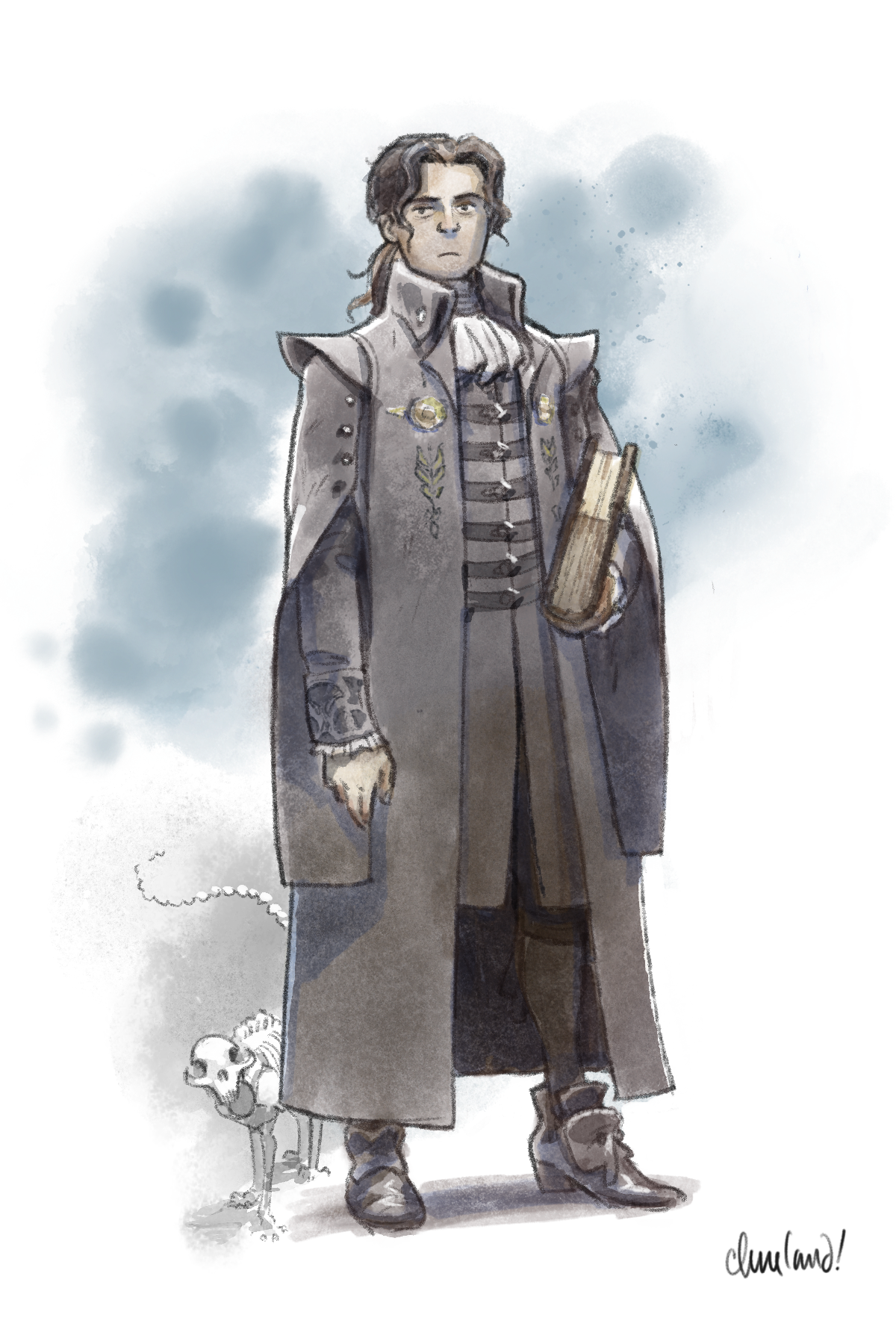 VICTOR VALLAKOVICH
Victor noticed them immediately and stopped short. “Oh. You’re the outsiders my father mentioned.” His tone suggested he wasn’t sure whether their presence was an inconvenience or a potential opportunity. “I assume you’re here for research?”
What followed was an unexpectedly natural conversation. Despite his awkward manner and obvious social inexperience, Victor quickly bonded with the party over their shared contempt for his father. When Arden muttered something about the Baron’s festivals being ridiculous wastes of time and resources, Victor’s face lit up with the first genuine smile they’d seen. “Finally, someone else who sees it! My father is an absolute fool who thinks happiness can be mandated by law. It’s embarrassing.”
Arden, ever direct, suggested that perhaps someone should simply kill the Baron and be done with it. Victor blinked, looking both startled and oddly pleased. “Well, I wouldn’t go quite that far, but I appreciate the sentiment.”
As the conversation continued, Choppy noticed the symbol embossed on Victor’s spellbook cover: an intricate sigil combining arcane elements in a distinctive pattern. It was identical to the engraving on the platinum ring they’d been researching. “That symbol,” Choppy said, pointing. “What does it mean?”
Victor’s expression grew guarded, his hand moving protectively over the book. “Why do you ask?”
Two revelations tumbled out simultaneously. First, Choppy explained about the ring found at the site of Arabelle’s abduction and their need to identify it. Second, Arden and Fig told Victor about the ghostly visitation that morning—an incorporeal entity that had written “Help Victor” in frost and identified itself as Erasmus.
At the mention of Erasmus’s name, Victor’s face went through a rapid series of expressions: shock, guilt, defensiveness, and finally resignation. “Erasmus,” he muttered. “That meddling… I told him I had the situation under control.”
Varnish cleared his throat. “We should also mention—your father asked us to investigate a haunting in the manor.”
“Of course he did,” Victor sighed. “Because he can’t even recognize when his own house is trying to tell him something is wrong.” He looked at the party, seemed to assess their capabilities and trustworthiness, and made a decision. “All right. You want answers about the ring? I can provide them. But in exchange, I need your help with something considerably more complex. And for that conversation, we need privacy.” He gestured toward the door. “Follow me to my workroom.”
Initially, Victor seemed reluctant to share details about his spellbook, clutching it like a lifeline. But when the party explained the urgency of Arabelle’s situation—a child taken by vampires, a father desperate for his daughter’s return—something shifted in his expression. “A child,” he said quietly. “Taken by Strahd’s servants. Yes, that… that changes things.”
He held up the spellbook. “This belonged to an archmage named Khazan. I found it here in the library several years ago—my father never noticed it was missing. The sigil on the cover was Khazan’s personal mark. I’ve been using it to teach myself proper magic, since my father certainly wasn’t going to hire me a tutor.” There was bitterness in that last statement.
“As for the ring,” Victor continued, “if it bears the same sigil, then it likely belonged to Khazan as well. Which means whoever took your Vistani girl may be connected to Khazan’s tower, or at least familiar with his work. But we can discuss that more upstairs. Right now, I need to show you something—and someone—who desperately needs your help.”
The party realized then that Victor hadn’t come to the library by chance—he’d been searching for a specific tome. “I was looking for Ethereal Entities,” he admitted when pressed. “It’s one of Mordenkainen’s books, the one that contains the ritual I need. But what I have to show you… it’s better if I just show you. Words won’t do it justice.”
With that cryptic statement, Victor led them from the library toward the upper reaches of the manor, where secrets waited in an attic workroom.
Victor’s Workroom
Victor led them through the manor’s upper floor to the master bedroom—his parents’ chamber, vacant at this hour. Without ceremony, he reached up and pulled down a trapdoor in the ceiling, releasing a folding ladder. “Watch your step,” he said tersely, already climbing. “And try not to touch anything.”
The attic was a maze of discarded wealth: furniture draped in dusty sheets, portrait frames stacked against walls, trunks overflowing with moth-eaten finery, and countless other relics of generations of Vallakovich excess. Through the mountainous clutter wound a narrow path, barely wide enough for a single person. Victor moved along it with practiced confidence, not bothering to check if they were following.
At the far end of the attic stood a door that immediately set off alarm bells. A skull was painted on its surface in white paint, surprisingly well-executed, and a hand-lettered sign nailed above it read: “ALL IS NOT WELL.”
Victor stopped at the door and turned to face them with unusual seriousness. “Do not touch the skull. It’s trapped. I’ll open it.” He gripped the handle carefully and swung the door inward, holding it open so they could pass through without triggering whatever magical ward he’d placed on the painted symbol.
The workroom beyond was cramped but organized in its own chaotic way. Tables lined the walls, their surfaces strewn with parchment covered in arcane diagrams, mathematical calculations, and sketches of magical circles. In the corner stood a floor-length mirror in an ornate frame, its surface oddly dark despite the candlelight. Against one wall sat a large wooden chest, and lounging atop it was something that made several party members do a double-take: a skeletal cat, curled into a perfect loaf shape, its empty eye sockets somehow managing to convey feline contentment.
“That’s just Patches,” Victor said dismissively, noticing their stares. “He’s harmless. Mostly just sleeps.”
The floor bore the most striking feature: a large runic circle inscribed in silver paint, its symbols complex and meticulously drawn. Whatever this was, Victor had been working on it for a long time.
“All right,” Victor said, closing the door behind them and leaning against his workbench. “Let’s start with what you need to know about Khazan.”
He laid out the information methodically: Khazan was an archmage of considerable power who had lived—and perhaps died—somewhere in Barovia. The symbol they’d found on the ring was his personal sigil. Most importantly, Khazan had built a tower on Lake Baratok, west of Vallaki, and imbued it with powerful enchantments. One of those enchantments was a protective field that prevented other spellcasters from using magic within its influence—a security measure that also made it incredibly difficult to breach.
“If the ring belongs to Khazan, or someone who served him, then investigating the tower might give us clues about Arabelle’s disappearance,” Victor explained. “But I need something in exchange. If you go to the tower, and if you find any magical artifacts or tomes, I need you to bring them back to me. Khazan’s knowledge could be invaluable.”
The party agreed, and Victor provided directions: “The tower sits at the end of a gravel causeway extending into Lake Baratok. I don’t know the best route to reach it, but Szoldar Szoldarovich would—he’s a wolf hunter who knows the wilderness better than anyone. My father dragged me on one of his hunting expeditions last year ‘in an effort to make me more manly.‘” Victor’s tone made clear what he thought of that particular endeavor. “I hated every minute, but Szoldar impressed me. He knows these woods like they’re his own house. Hire him as a guide.”
That matter settled, Victor’s expression grew more conflicted. “Now, about Erasmus’s request, and the haunting.” He paused, seeming to gather his courage. “What I’m about to show you will explain both. Please don’t panic. Don’t be angry. And definitely don’t be afraid.”
He turned toward the mirror in the corner. “You can come out now.”
The surface of the mirror rippled like water, and a spectral form began to coalesce within it. A teenage girl materialized, ethereal and translucent, her features delicate and her expression shy. She gave the party a small, tentative wave but remained silent, watching them with eyes that held depths of fear and fading hope.
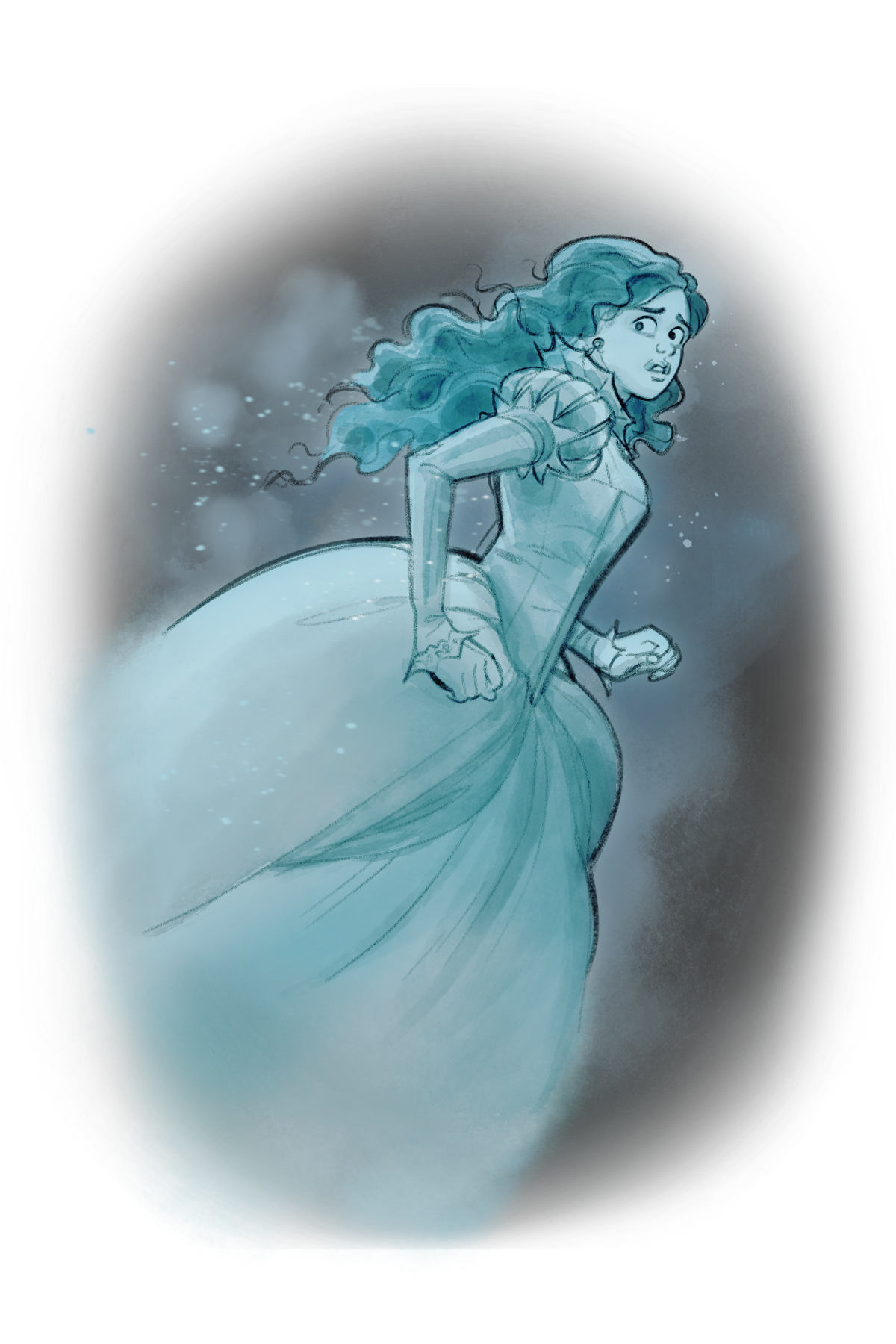 STELLA WACHTER’S GHOST
“This,” Victor said quietly, “is Stella Wachter. Daughter of Lady Fiona Wachter. I’m sure you’ve heard the rumors about her being confined to the estate for mysterious reasons.”
The party nodded, remembering what Urwin had told them about Stella’s sudden illness.
Victor took a breath and told them the story: Three months ago, shortly after Strahd awakened and Barovia’s horrors intensified, Victor and Stella had conceived a desperate plan. Using Khazan’s spellbook, Victor had been working on constructing a teleportation circle—a means of escape from this cursed valley. They built a prototype, tested it on small animals (mostly undead rabbits Victor had animated for the purpose), and when it seemed to work, Stella volunteered to be the first human subject.
The experiment had gone catastrophically wrong.
Instead of teleporting, Stella’s soul had been ripped from her body and trapped in the Ethereal Plane—that ghostly realm that existed parallel to the material world. She’d been attacked by something Victor called a “gallows speaker,” a dark shadow that fed on souls. Her essence had been severed from her physical form, which now lay catatonic at Wachterhaus, empty and mindless.
“She should have died within hours,” Victor said, his voice thick with guilt. “The tether connecting her soul to her body should have snapped. But Erasmus—the ghost you encountered this morning—found her in the Ethereal Plane and protected her. He’s been keeping the shadows at bay ever since. But she’s fading. Sometimes she can’t remember who she is. Sometimes she thinks she’s someone else entirely, curled up in some warm, wet place with a heartbeat echoing around her. She has perhaps a week left. Maybe less.”
The spectral Stella watched them, her translucent hands clasped in front of her, saying nothing. The weight of her desperation was palpable even through the ethereal barrier.
Victor continued: “I’ve found a way to rescue her. There’s a ritual described in one of these books—Ethereal Entities: Denizens of the Unseen Realm. It can temporarily transport living creatures into the Ethereal Plane, where we can reverse what went wrong and bring Stella’s soul back to her body. But the ritual requires a rare component: a night hag’s heartstone.”
He pulled out a sheaf of notes covered in sketches. “Erasmus has been observing Vallaki from the Ethereal Plane. He’s seen a creature matching a night hag’s description haunting the Refugee Camp outside the eastern gate. The timing fits, too—the refugees have been reporting nightmares, fatigue, people waking screaming in the night. Classic signs of hag predation.”
Choppy made the connection immediately. “Morgantha. The old woman selling dream pastries. I knew there was something wrong about her.”
“Exactly,” Victor confirmed. “So here’s what needs to happen: you investigate the refugee camp. Find proof that Morgantha is the hag. Ideally, get her heartstone—but if you can’t, at least confirm her identity and routine so we can plan an ambush. We perform the ritual on the night of the full moon, which gives us…” he calculated quickly, “about five days.” Victor then offered the book to Varnish, saying that he was welcome to borrow it in order to prepare for their encounter with the night hags.
He looked at Stella’s ghost, and his voice dropped to almost a whisper. “I won’t let you fade. I promise.”
Stella’s spectral form flickered, like a candle in a draft, and a mischievous smirk appeared on her face.
Victor caught the expression and frowned. “Wait. Stella, have you been… the moving objects? The cold drafts? The servants seeing reflections in mirrors?” His voice carried equal parts exasperation and relief. “You’ve been playing pranks on my family’s household staff?”
The ghostly girl’s smirk widened, and she gave a small, unapologetic shrug. Clearly, being trapped between life and death hadn’t entirely dampened her sense of humor.
“That’s… actually brilliant,” Victor admitted, running a hand through his hair. “My father’s been driving himself mad trying to explain it away. Though it did cost us a butler and a lady-in-waiting.” He paused, then asked more gently, “Have you considered doing the same at your own house? Getting your mother’s attention? Letting her know you’re still… here?”
Stella’s playful expression faded. She shook her head slowly, then began moving her hands in what the party recognized as sign language. Victor translated: “She says she can’t. She’s tried to approach Wachterhaus dozens of times, but there’s something—a barrier, an invisible wall—that prevents her from getting close to the property. She can’t even see inside the windows.”
The revelation hung heavy in the air. Some force was keeping Stella’s spirit away from her own home, from her own mother. Whether this was a protective ward Lady Wachter had placed, some darker magic, or a consequence of Stella’s ethereal state remained unclear. But it explained why Stella had been haunting the Vallakovich Manor instead—it was the closest she could get to the only person who knew what had happened to her.
The party stood in silence, processing everything they’d just learned. A missing Vistani girl taken by vampires. A trapped soul slowly dissolving into nothing. A night hag preying on desperate refugees. A wizard’s tower full of secrets. And somehow, all of it connected by threads of old magic and new horrors.
“So,” Varnish said finally, “busy week ahead of us.”
Victor actually smiled at that—a brief, genuine expression of relief that someone else was sharing the burden. “Yes. Very busy. Now, speaking of which—didn’t you mention having dinner plans with Stella’s mother tonight?”
The party exchanged glances. They’d almost forgotten: Lady Wachter’s invitation, delivered days ago, requesting their presence at Wachterhaus this very evening.
This was going to be an interesting dinner conversation.
Dinner at Wachterhaus
As twilight settled over Vallaki—or what passed for twilight in Barovia’s endless gloom—the party made their way through the town’s northern district toward Wachterhaus. The weight of secrets pressed upon them: Stella’s trapped soul, Ireena’s impossible history, Arabelle’s abduction, the night hag lurking among refugees. Every new revelation seemed to spawn three more mysteries, tangling together in ways they couldn’t yet comprehend.
The Wachter estate appeared through the evening mist: a wide, red-roofed manor surrounded by thick gardens filled with herbs and vines. A slouching roof hung heavy over furrowed gables, and moss-covered walls sagged and bulged under vegetation’s weight. Yet despite its weathered appearance, the property radiated an air of old nobility—dignified decay rather than ruin.
Arden knocked on the handsome red door, its upper half set with frosted glass. Within moments, it swung open to reveal a prim and proper gentleman in impeccable butler’s attire. “Good evening,” he said with a slight bow. “I am Haliq, Lady Wachter’s valet. The lady of the house has been expecting you. Please, come in.”
Haliq’s manners were flawless as he offered to take their coats and belongings, and his demeanor gracious when they understandably refused to part with their gear. He led them through the entry hall, past the staircase, and the party caught the delicious aromas wafting from an open kitchen door—roast lamb and stewed vegetables, herbs and fresh bread. Through the doorway, they glimpsed a cook named Dhavit working diligently over his preparations, basting a leg of lamb with practiced efficiency.
“Lady Wachter will join you shortly,” Haliq said, guiding them into a well-appointed parlor. “Please make yourselves comfortable. I shall fetch refreshments.”
The parlor was tastefully furnished with upholstered chairs, side tables bearing oil lamps, and walls decorated with portraits of stern-looking ancestors. Fig, ever the investigator, scanned the room for anything suspicious or out of place. But everything seemed perfectly ordinary—no sinister artifacts, no hidden compartments, just a comfortable room awaiting its guests.
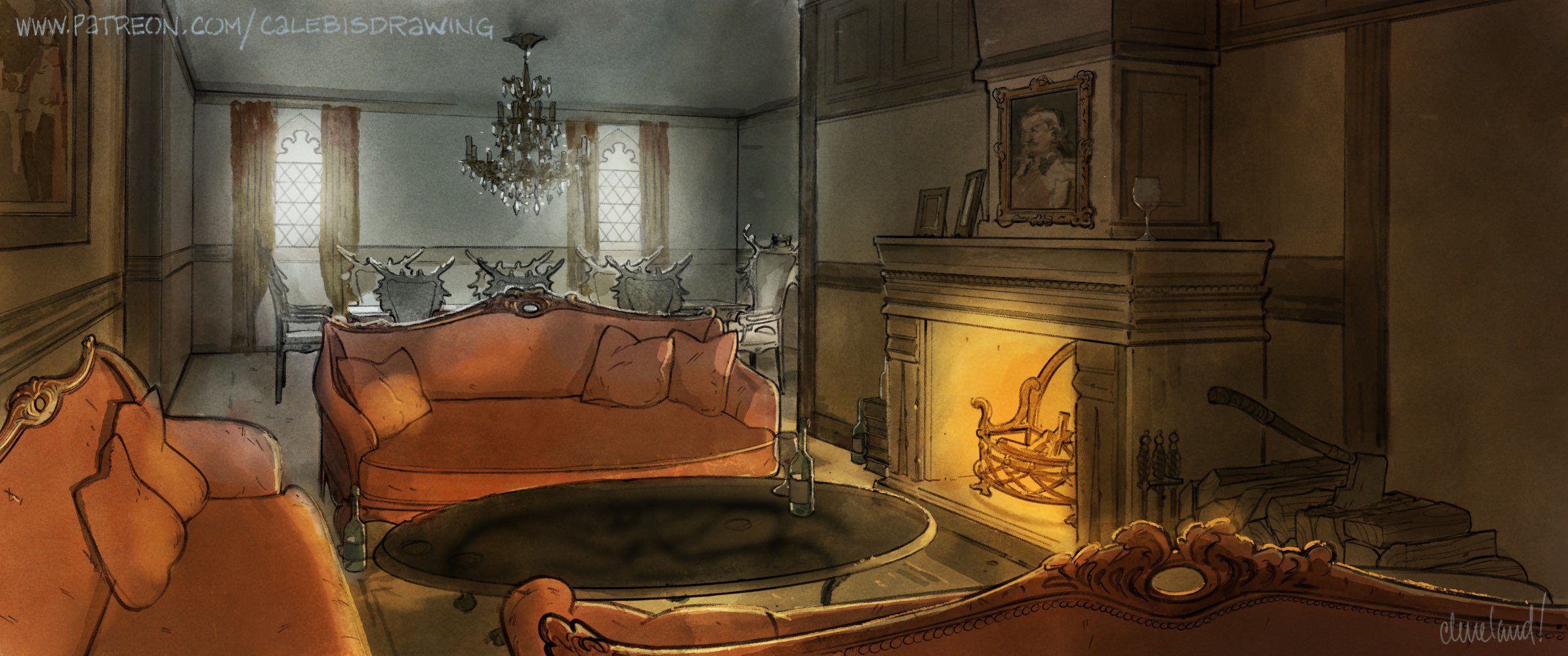 THE WACHTERHAUS PARLOR
As Haliq departed to retrieve wine and spirits, the party settled into their seats, the weight of their knowledge about Stella pressing heavily on their minds. They were here, in her mother’s house, knowing the girl’s soul was trapped in a mirror miles away while her body—
A figure appeared in the doorway leading back to the staircase: a young woman in white nightgown and slippers, approximately sixteen years old. She stood perfectly still, staring vacantly into space toward them but making no eye contact. Her face was blank, expression completely empty, as if no one was home behind those eyes.
This was Stella’s physical form. The empty shell Victor had described.
Before anyone could react, footsteps thundered down the staircase and Nikolai Wachter stumbled into view, breathing hard. “Stella!” he exclaimed worriedly. “How did you—I’m so sorry,” he said, turning to the party with an apologetic expression. “I don’t know how she wandered down here. I’ll get her out of your way.”
As Nikolai reached for his sister’s arm to guide her back upstairs, Arden stepped forward instinctively. The paladin had developed something of a protective streak, especially where the helpless were concerned, and seeing Stella in this state stirred that impulse. “Is she all right? Does she need—”
Nikolai, startled by Arden’s sudden movement, raised his hands defensively and stepped between his sister and the stranger. The gesture was protective, almost aggressive, and for a moment tension crackled in the air.
Arden stopped, hands raised in a peaceful gesture. “Easy,” he said. “I’m not going to hurt her.”
Ps
The first player to read this and send me their rose, bud, and thorn from Session 13 gets a point of heroic inspiration!
The moment hung there, two men facing off over a catatonic girl—and then Varnish muttered, “Here we go again with the throat chops,” referencing a previous incident where Arden’s protective instincts had manifested as violence against perceived threats. The comment broke the tension with unexpected humor.
Before the situation could escalate further, a new voice cut through the parlor with calm authority: “Nikolai.”
Lady Fiona Wachter stood in the doorway from the kitchen, a glass of brandy in one hand, her posture perfectly composed. She was a striking woman in her forties, with sharp features, dark hair styled elegantly, and eyes that missed nothing. She wore fine clothes appropriate for hosting dinner, and her entire bearing radiated controlled dignity.
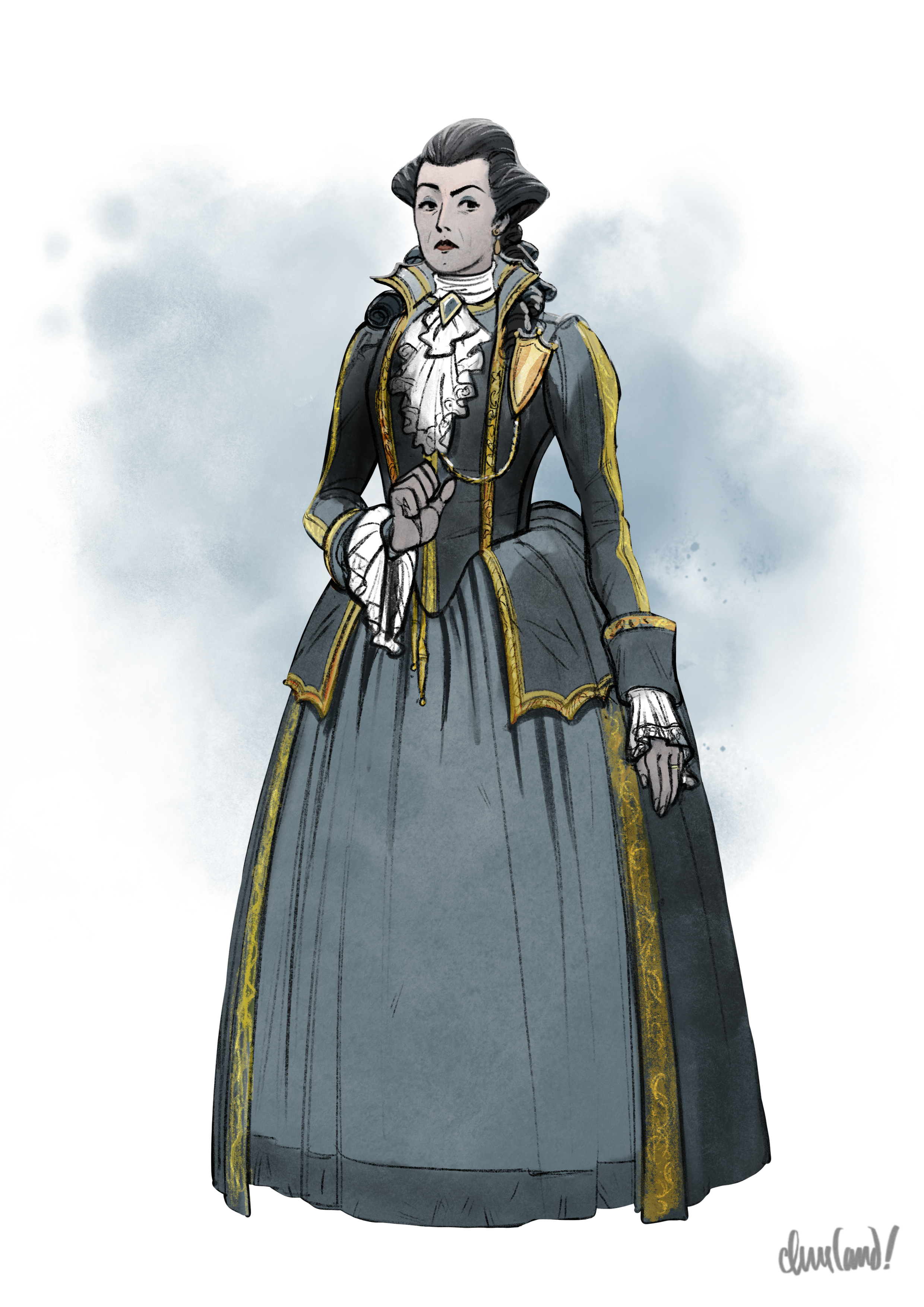 LADY FIONA WACHTER
“Yes, mother,” Nikolai said immediately, his defensive posture easing.
“I believe you intended to take your sister for a walk in the gardens this evening,” Lady Wachter said, her tone gentle but firm. “It’s a brisk night, Nikolai. Please ensure she’s warmly dressed, and that she neither trips nor injures herself.”
“Of course, mother.” Nikolai retrieved a shawl from a hook near the door and wrapped it carefully around Stella’s shoulders before guiding her gently toward the side entrance. The vacant-eyed girl followed his lead without resistance, her slippered feet shuffling across the floor. Within moments, they were gone.
Lady Wachter turned her full attention to the party, and a smile touched her lips—reserved but warm, the expression of someone who had long ago mastered the art of diplomatic courtesy. “Welcome to Wachterhaus,” she said, moving into the parlor with practiced grace. “I do apologize for that interruption. My daughter has been… unwell these past months. But please, make yourselves comfortable. Haliq will return with drinks momentarily, and dinner will be served shortly thereafter.”
As if on cue, Haliq reappeared bearing a silver tray with crystal glasses. He served brandy to Lady Wachter, Fig, and Choppy, each pour measured with practiced precision. The others declined, preferring to keep their wits sharp in this uncertain situation. Haliq bowed slightly and departed once more, leaving them to their conversation.
Lady Wachter settled into a high-backed chair with the bearing of someone accustomed to command, crossed her legs elegantly, and regarded her guests with cool, appraising eyes. “Now then,” she said, taking a sip of her brandy, “shall we get acquainted?”
And so the evening’s real conversation began.
Navigation
- Previous Session: Session 12 - Into the Bone Zone
- Next Session: Session 14 - Dinner and a Show