Session Summary
Your evening at Wachterhaus began with brandy, small talk, and careful assessment. Lady Fiona Wachter questioned each of you in turn—about Fig’s katana, Varnish’s clarinet, Arden’s devotion to Hoar, and Choppy’s untrained sorcery. Over a sumptuous dinner of roast lamb and fresh bread, she probed your opinions of Vallaki and its leadership, her satisfaction evident when you criticized the Baron’s oppressive rule. She shared the history of the Vallakovich family, Izek Strazni’s mysterious rise to power, and the suspicious timing of Baron Valentin’s death with Izek’s acquisition of his demonic arm. When Arden bluntly suggested someone should kill the Baron, Lady Wachter seemed both startled and pleased by such directness.
Lady Wachter recounted the cautionary tale of Berez—a fishing village that defied Strahd three centuries ago and was swallowed whole by the rising Luna River. She spoke of pragmatism over hope, quoting the teachings of Ezra, goddess of the Mists, who counsels her followers to see the world as it truly is rather than as they wish it to be. When challenged about her loyalty to Strahd, she explained that survival requires bending like the willow rather than breaking like the oak, though she conceded she might reconsider her position should Madam Eva’s prophesied Sunsword actually be found.
The conversation turned to conspiracy. Lady Wachter revealed her true purpose: she needed Izek dead before any political change could occur in Vallaki. She asked you to follow him, find him vulnerable, kill him, and bring his head as proof. In exchange, she promised silvered weapons, safe passage for the Barovian refugees, and compensation. You agreed without hesitation—Izek’s cruelty had earned him this fate. But there was another matter to address: Stella.
After detecting the protective circle surrounding Wachterhaus, you told Lady Wachter the truth about her daughter’s condition—soul severed from body, trapped in the Ethereal Plane, slowly fading. She believed it a cruel joke until you convinced her to lower the circle. Stella’s spirit proved her presence by delivering a peony to her mother’s lap and arranging teacup shards into a crescent shape—the mark of Luna, Stella’s childhood cat. Lady Wachter wept, then steeled herself. You explained your plan to confront the night hags of Old Bonegrinder, obtain a heartstone, and rescue Stella. Lady Wachter promised to create a binding circle to trap the hags, provided you obtained their true names first. As a token of faith, she gave Varnish her personal Tarokka deck as his new spellcasting focus.
Returning to the Blue Water Inn, you found it ransacked. Izek Strazni had torn through the building searching for Ireena, breaking furniture and stealing the Martikovs’ savings. Racing to St. Andral’s Church, you confirmed Ireena’s safety—but also shared the disturbing discovery from the Baron’s library: records of an “Ireena Strazni” who died eighteen years ago, survived by her brother Izek. Ireena rejected any connection to that past life, declaring that whoever she might have been died in the forest years ago. When you explained your plan to kill Izek, she wrote formal endorsement on parchment: “I, Ireena Kolyana, do hereby endorse the beheading of Izek Strazni.” The hunt would begin tomorrow.
Brandy and Small Talk
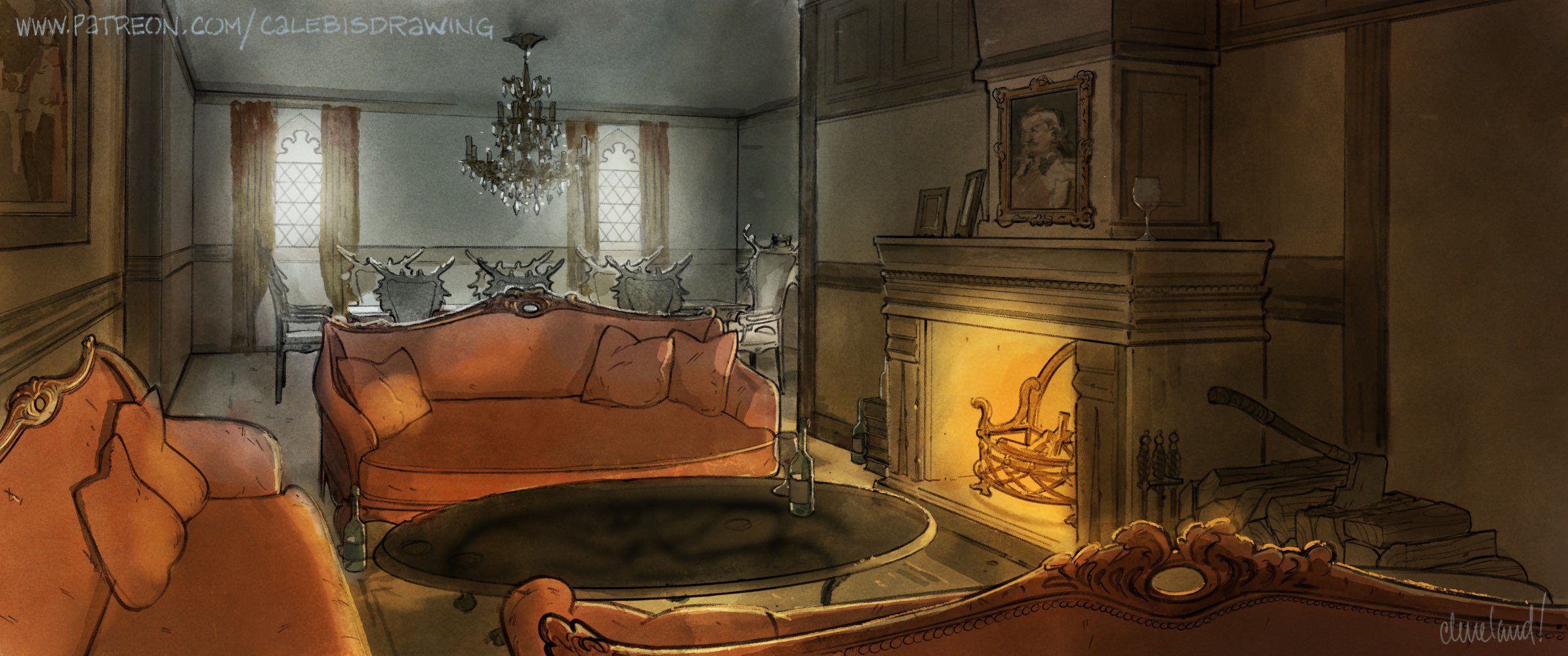 WACHTERHAUS PARLOR
The evening had barely begun when Lady Fiona Wachter settled into her chair with practiced elegance, a crystal glass of brandy cradled in one hand, her sharp eyes moving from guest to guest with the cool assessment of someone accustomed to measuring others. The parlor of Wachterhaus was warm despite the chill autumn air outside, lit by oil lamps that cast dancing shadows across the walls adorned with portraits of stern-faced ancestors. The party sat arrayed on upholstered couches, some nursing glasses of wine while others remained alert and watchful.
“Now then,” Lady Wachter said, her voice cultured and measured, “I confess I know very little about my guests this evening, save what reputation and rumor provide—and both, I find, are notoriously unreliable sources.” A slight smile touched her lips. “Shall we remedy that?”
Her questions were directed with precision, each player singled out in turn as she worked to understand the strangers who had entered her home. To Fig Fleetfoot, she gestured at the elegant katana at their side. “A beautiful weapon,” she observed. “Such craftsmanship is rare in these lands. Where did you come by it?” Fig’s answer—that it was a relic of their past training at a distant monastery—drew a thoughtful nod, and Lady Wachter’s gaze moved on.
Varnish Gothorn found himself the subject of inquiry next as Lady Wachter’s eyes settled on the clarinet case at his side. “A musician,” she noted with what might have been approval. “How refreshing. Music has been in short supply in Vallaki of late—the Baron’s festivals hardly count, I’m afraid. Do you play for pleasure, or profession?”
Varnish shared that he used to just fiddle about but had recently discovered some new abilities involving the use of his clarinet to conjure spirits from beyond the veil, from whom tales of power could be coaxed. This seemed to satisfy the Lady, though her expression remained difficult to read.
Arden Nalero’s turn came when Lady Wachter’s attention fixed on the distinctive breastplate he wore. “And this,” she said, leaning forward slightly, “is magnificent, though I’m afraid I don’t recognize the sigil… what meaning does it hold?” Her tone held no judgment, only curiosity.
Arden told her about his devotion to Hoar, the Doombringer. “An interesting patron for one traveling through Barovia. May I ask what brought you to his service?” Arden’s response drew a contemplative and sympathetic silence before she moved on.
Finally, her gaze settled on Choppy Gibbles, and she tilted her head slightly. “And you, young man. I sense power about you—the kind that comes not from books and tutors, but from something… innate.” She paused, considering. “Tell me, where did you receive your training in the arcane arts? Or did you, perhaps, find magic came to you without such formal instruction?”
Choppy’s answer—that his magical abilities had indeed manifested without formal training—drew the first genuine expression of interest from their host. “Fascinating,” she murmured. “A sorcerer, then. Wild magic, or perhaps something in your bloodline?” She sipped her brandy thoughtfully. “In any case, you have my sympathies. Magic without a teacher can be… unpredictable.”
Throughout the exchange, Lady Wachter maintained her composure—cordial yet cautious, welcoming yet watchful. She was feeling them out, the party realized, assessing not just their capabilities but their character. And behind those measuring eyes lay calculations they could only guess at.
Haliq reappeared briefly to announce that dinner would be served shortly, and the conversation shifted to lighter matters—the quality of Wachterhaus’s wine cellar, the architecture of Vallaki’s older buildings, the changing of the seasons. But beneath the pleasantries, everyone in that parlor understood that the real conversation was yet to come.
The Vallakovich Problem
Dinner was a surprisingly sumptuous affair given the general scarcity that plagued Vallaki. Roast leg of lamb, tender and herb-crusted, occupied the center of the table alongside bowls of stewed vegetables, boiled potatoes seasoned with butter and rosemary, and fresh-baked bread that filled the dining room with its warm aroma. Dhavit, the cook, had clearly outdone himself.
As the party settled into their meal, Lady Fiona Wachter posed her opening question with the same calculated precision she’d employed in the parlor. “Tell me,” she said, cutting delicately into her lamb, “what do you think of Vallaki, given the time you’ve spent within its walls? How does it compare to your homelands?”
The question seemed innocent enough, but the party had learned to recognize when they were being tested. Their answers were candid—perhaps more so than Lady Wachter had expected. They spoke of the oppressive atmosphere, the festivals that felt more like theater than celebration, the refugees suffering outside the gates while the Baron obsessed over mandatory happiness.
Lady Wachter’s expression shifted subtly as they spoke, satisfaction flickering behind her eyes. “I’m gratified to hear such honesty,” she said. “And impressed. Not many would dare voice such criticisms openly, even in private company.” She set down her fork and leaned back slightly. “I heard, of course, of your actions in the town streets yesterday morning. Your willingness to defy the Baron’s will in defense of Willemina Rikalova. It was… noted.”
Arden, never one for subtlety, seized the opening. “The Baron is a fool,” he said bluntly. “His festivals are a waste of time and resources. Someone should simply kill him and be done with it.”
A moment of silence fell over the table. Lady Wachter blinked, looking both startled and oddly pleased. “Well,” she said after a beat, a small smile playing at her lips. “I wouldn’t go quite that far, but I appreciate the directness of your sentiment.”
With the ice thoroughly broken, Lady Wachter began to share what she knew—or what she wanted them to know—about Vallaki’s leadership. Her voice took on a lecturer’s cadence as she outlined the history of the Vallakovich family.
“The Vallakoviches have ruled Vallaki since its founding nearly five hundred years ago,” she began. “Boris Vallakovich, the first patriarch, built these walls and claimed royal blood ran in his veins—a claim his descendants have never ceased to trumpet. They believe themselves superior to all others in this valley.” She paused to sip her wine. “The current Baron is no different, though his particular brand of arrogance has taken… troubling forms.”
She recounted how Vargas had come to power eleven years ago following the sudden death of his father, Baron Valentin Vallakovich. “Barely fifty years old,” Lady Wachter noted, her tone carefully neutral. “In near-perfect health. And yet he passed in his sleep.” Her eyebrow arched slightly. “No foul play was ever proven, of course. But I have always harbored… suspicions.”
The Baron’s obsession with happiness and festivals, she explained, had once been merely eccentric. But since Strahd’s awakening three months ago, it had metastasized into something far more sinister. Mandatory attendance at festivals. The criminalization of “malicious unhappiness.” The stocks filled with those whose faces didn’t show sufficient cheer.
“Worse still,” Lady Wachter continued, her voice hardening, “he has barred the refugees from Barovia from entering the town. Families fleeing the Devil’s servants, forced to camp in the mud outside our walls while Vargas prattles about maintaining Vallaki’s ‘happy spirit.‘” She set down her glass with controlled precision. “It is an abuse of power that has caused enormous suffering to people who have already lost everything.”
And then there was Izek Strazni.
Lady Wachter’s expression grew darker as she spoke of the Baron’s enforcer. She laid out his history with cold efficiency: the orphaned boy who’d lost his arm and sister to wolves, whose tormentors had mysteriously disappeared, who’d been taken in by the young Vargas under circumstances no one quite understood. And then, at sixteen, the miraculous—or cursed—regrowth of his arm into something decidedly inhuman.
“The same day that arm appeared,” Lady Wachter said quietly, “was the same day Baron Valentin Vallakovich died in his sleep. I am confident the two events are connected, though I cannot say how.”
She described Izek’s reign of terror with clinical detachment—the battery, the arson, the extortion. All of it sanctioned, even encouraged, by the Baron. “The townsfolk fear him,” she said. “And that fear has slowly extended to Vargas himself. But Izek’s strength protects them both, dispatching anyone foolish enough to defy them.”
The conversation took a more personal turn when Lady Wachter spoke of her daughter, Stella. Her voice, which had remained so controlled throughout dinner, wavered slightly.
“Six months ago, against my counsel, Stella began visiting Victor Vallakovich—the Baron’s son.” She looked down at her plate. “I warned her. I told her that entanglement with that family would bring only sorrow. But she was young, and headstrong, and she believed she knew better.”
What came next was delivered with barely suppressed fury: two months ago, Izek Strazni had returned Stella to Wachterhaus in her current state—mindless, speechless, unable to care for herself. And when Lady Wachter had demanded answers, the Baron had dismissed her concerns with vague insinuations about fragile constitutions and exposure to “the Devil’s influence.” Victor himself refused to speak of it at all.
“Whether they did something terrible to her or merely allowed something terrible to happen, I cannot say,” Lady Wachter said, her knuckles white around her wine glass. “But their cold refusal to even acknowledge their role in her suffering proves—beyond any doubt—that they are unfit to lead this town.”
The party exchanged glances. They knew far more about Stella’s condition than Lady Wachter suspected, but this was neither the time nor the place to reveal it. Not yet.
Lady Wachter seemed to sense their discomfort and changed the subject smoothly, turning to administrative matters. When Fig asked about the actual duties and powers of a burgomaster—a question born of genuine concern for Vallaki’s people—Lady Wachter’s expression softened.
“A fair question,” she acknowledged. “Burgomasters settle disputes, maintain town records, coordinate defenses. We collect taxes—or we would, if Strahd had demanded any in the past century.” A wry smile. “We also pay the guards’ salaries and can levy local taxes for town needs. But our powers are limited. We have only the authority the town grants us. A burgomaster is an administrator, not a tyrant—though the current Baron seems to have forgotten that distinction.”
The party’s concern about her disposition toward Strahd hung unspoken in the air until Fig finally asked it directly.
Lady Wachter paused, considering her words with visible care. “I am, and have always been, a realist,” she said finally. “Some may prefer to live in a realm not ruled by Strahd von Zarovich. But we do live in such a realm, and we must learn to come to terms with it.” She met Fig’s eyes steadily. “Unlike Vargas, Strahd is at least capable of reason. That may not be comforting, but it is the truth as I see it.”
The Ruin of Berez: A Cautionary Tale
The plates had been cleared away and replaced with small bowls of preserved fruit and cheese when the conversation turned darker still. Fig, still probing Lady Wachter’s political positions, asked about her views on resistance to Strahd’s rule—whether she believed escape or defiance was possible.
Lady Fiona Wachter’s response came in the form of a story, delivered with the cadence of someone who had told it before and expected to tell it again.
“Barovia, Vallaki, and Krezk,” she began, setting down her wine glass. “This land’s three lights of civilization. Did you know, however, that there was once a fourth?”
She painted a picture of Berez—a fishing village built on the banks of the Luna River, thriving and prosperous in its prime. Full of life, hope, and laughter. And then, more than three centuries ago, its burgomaster had defied Strahd’s will.
“The details are lost to time,” Lady Wachter said, her voice quiet but steady. “But the histories make clear that Berez believed itself capable of challenging the Devil’s rule. Whether it was pride, desperation, or mere foolishness, I cannot say.” She paused. “But it was, nonetheless, a grave mistake.”
Strahd, she explained, had not argued or negotiated. He had simply commanded the Luna River to rise. And it obeyed. The waters swallowed Berez whole, leaving no building standing and few lives spared. The survivors—broken, lost, and adrift—had struggled north to Vallaki, where they’d forged new lives among the ruins of the old.
“What did defiance earn Berez?” Lady Wachter asked rhetorically. “A marsh and some broken stone. A stark, cold warning to anyone who would follow their path.”
Her expression grew distant, almost wistful. “As a child, I once heard a tale of a sword that shone with the fury of the sun—a mighty weapon indeed, and one that would dawn a new age for Barovia.” She smiled sadly. “In my dreams as a little girl, I imagined finding it. But a lady cannot waste time on fairy tales or fools’ errands. She must take the world as it is, not the way she wishes it to be.”
The point was clear: survival required pragmatism. A lord at peace could be reasoned with, even ignored if sufficient assurances were paid. But a vengeful lord could not be so easily dismissed.
“Defiance leads to nothing but destruction,” Lady Wachter concluded. “Berez learned this the hard way. It is our duty—our obligation, to both our ancestors and to our children—to take that lesson to heart.”
The party bristled at this, several of them preparing arguments about hope and the Morninglord and the prophecy from Madam Eva. But Lady Wachter cut them off with a raised hand.
“It is popular among the Barovian people to worship the Morninglord,” she said, an edge creeping into her voice. “Especially now, with Strahd recently returned. Fervent worshippers proclaim the day when the Morninglord’s light shall return to the valley, a new dawn rising with the sun.”
She leaned forward. “I reject such illusions. Instead, I heed the word of Ezra, goddess of the Mists, who teaches her followers to look past one’s hopes—to recognize them as the fog that clouds the mind—and to see the world as it truly is and shall forever be.” Her voice softened slightly. “Ezra teaches endurance. After all, the oak fights the wind and is broken, but the willow bends when it must and survives.”
Lady Wachter went on to explain that Strahd was not so unreasonable as he might appear. She spoke of her ancestor, Lady Lovina Wachter, who had served Strahd faithfully as his vassal. When a traitor named Leo Dilisnya had murdered Lovina’s husband and attempted to kill Lovina herself, Strahd had defended her and hunted Dilisnya down to punish him. House Wachter had remained loyal to Strahd ever since.
“I do not begrudge others their hope,” she said carefully. “I do not seek to destroy that hope, nor bring pain where unnecessary. But in the meantime, I believe my people must bend like the willow in order to survive.” She looked at each of them in turn. “If you seek to oppose Strahd, I will lift no finger to stop you. I merely ask that you bring no harm to Vallaki as you do.”
It was Arden, still burning with righteous vengeance after conversation with Kasimir, who mentioned Madam Eva’s prophecy and the Sunsword. (Arden was mistaken, however, in believing his Broken Blade to be the same as this mythical sword of sunlight). Lady Wachter paused, something flickering behind her eyes—surprise, perhaps, or guarded hope.
“As much as the Vistana seer might believe what she saw,” Lady Wachter said slowly, “the future is notoriously difficult to interpret.” But then she smiled, just slightly. “Still. I confess I may be more willing to believe your arguments should this legendary sword actually be found.”
It was the closest thing to optimism the party had heard from her all evening.
Simple… Kill Izek
The moment had come for Lady Wachter to reveal the true purpose of this dinner invitation. She set down her glass and folded her hands in her lap, her expression grave.
“I must ask for your discretion,” she began, “as well as your promise that not a whisper of our conversation shall escape this room.”
When the party agreed, she proceeded with methodical precision:
“There are many in Vallaki who are uncomfortable with the Vallakoviches’ rule. Many who would prefer fresh leadership overseeing the town. However—” she paused for emphasis “—so long as Izek Strazni serves the Baron’s household, any attempt to shift the town’s political leadership would be met with violent brutality.”
She let that sink in before continuing. “Izek is utterly faithful to Baron Vallakovich. His life is the sole obstacle to the change Vallaki needs.” Her gaze swept across the party. “You appear to be capable, intelligent, and good-hearted individuals. Well-armed and well-trained. If any group could aid Vallaki in its hour of need, it would be you.”
The proposal was straightforward: follow Izek, find him when he was vulnerable and unaccompanied by guards, kill him, and bring his head to Lady Wachter as proof. The head would aid her efforts to persuade the Baron to step down peacefully.
“I have secured a bottle of poisoned wine,” she added, “that should dull his senses—impose the poisoned condition for an hour after he drinks it. He is formidable, yes, but not invincible.”
When the party demanded compensation, Lady Wachter promised them their selection of silvered weapons and ammunition from the town guard’s stores once she assumed power. They would also be welcome to keep Izek’s own silvered battleaxe and any valuables they recovered from his person.
And when the party mentioned the Barovian refugees, Lady Wachter’s response was swift and unreserved: “I promise to ensure the refugees will be permitted to safely enter the town as soon as Baron Vallakovich has been removed from power. You have my word.”
The party agreed without much hesitation. Whatever moral qualms they might have had about assassination evaporated in the face of Izek’s documented cruelty and the suffering he’d caused. This wasn’t murder—it was pest control.
Lady Wachter laid out the background on Izek’s mysterious fiendish arm and its suspicious timing with Baron Valentin’s death, reinforcing what she’d shared earlier. By the end of her explanation, there was no doubt in anyone’s mind: Izek Strazni needed to die.
“I will have one of my associates deliver the poisoned wine to you tomorrow morning,” Lady Wachter promised, “along with information about Izek’s schedule. From there, the execution is in your hands.”
Hey, Stella!!!
With the matter of Izek settled, the party realized they could no longer avoid the other pressing issue that had brought them here: Stella.
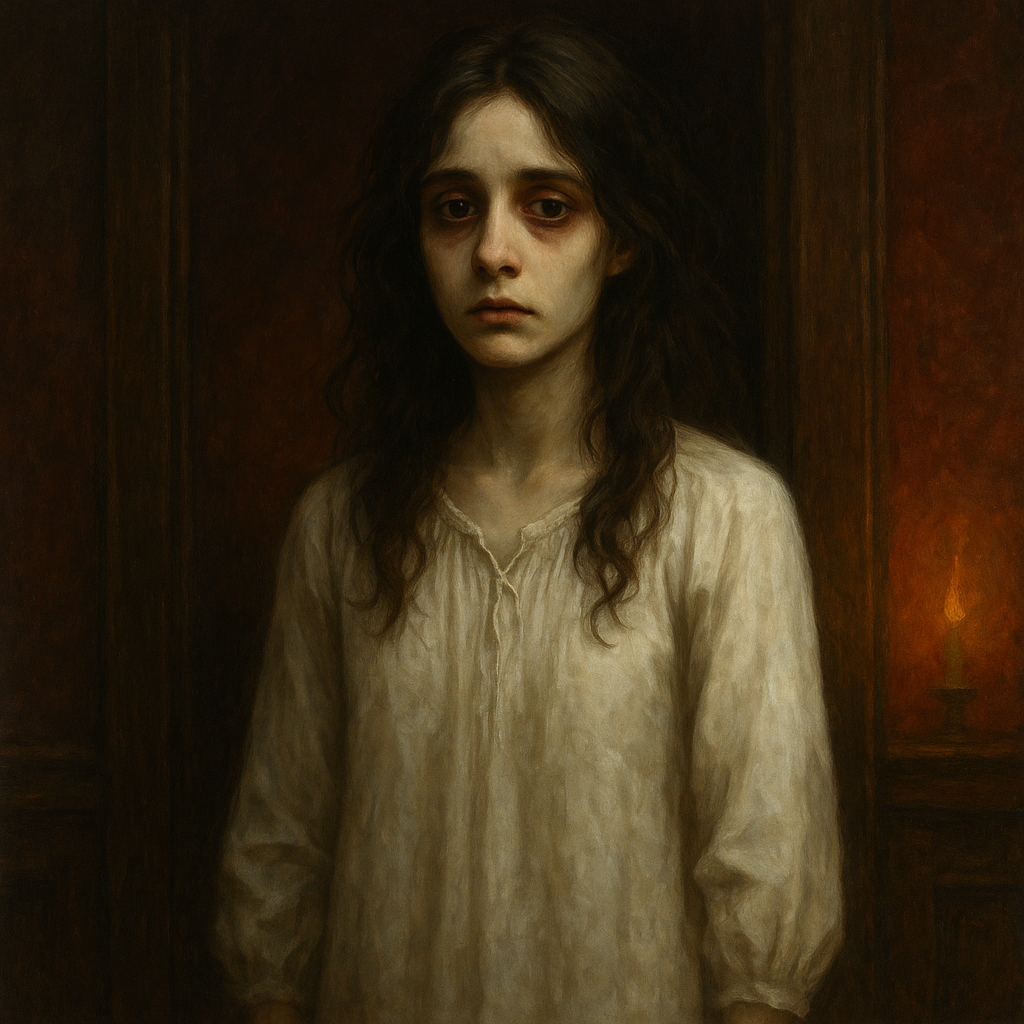 STELLA WACHTER’S SOULLESS BODY
Choppy and Arden both quietly cast Detect Magic, their arcane senses reaching out through the walls of Wachterhaus. Almost immediately, they felt it—a massive circle of protective magic surrounding the entire estate, thrumming with power designed to keep ethereal entities at bay.
A brief, whispered conference followed among the party members. Should they tell Lady Wachter the truth? Could she even be trusted with it? But looking at the grief and fury that had colored her voice when she’d spoken of Stella’s condition, they made their choice.
Directness and honesty. It was the best approach.
Varnish cleared his throat. “Lady Wachter, there’s something we need to tell you about your daughter. About what really happened to her.”
And so they explained everything: Victor’s teleportation circle experiment, the catastrophic failure, Stella’s soul torn from her body and trapped in the Ethereal Plane, the protective presence of Erasmus’s ghost, the slow fading of Stella’s essence. All of it.
Lady Wachter’s face went through a series of rapid transformations—disbelief, anger, suspicion. When they finished, her voice was cold.
“This is a cruel joke,” she said, her knuckles white as she gripped her armrest. “A vicious, heartless jest at the expense of a grieving mother. I don’t know what you hope to gain from this, but—”
“We can prove it,” Choppy interrupted gently. “But you’ll need to lower the protective circle around your house. Stella is here, right now, in the Ethereal Plane. She’s been trying to reach you for weeks, but the circle keeps her out.”
Lady Wachter’s eyes narrowed dangerously. “How do you know about the circle?”
“Stella told us,” Arden said. “Through Victor. She can see it, even if she can’t cross it.”
The skepticism in Lady Wachter’s expression warred with something else—a desperate, fragile hope that she was trying very hard to suppress. Finally, she stood.
“Wait here.”
She ascended the stairs to her bedchamber and returned moments later carrying a small, meticulously crafted model of Wachterhaus—every detail rendered in twigs, clay, and painted thatch. She set it on the parlor table and, with her eyes closed, murmured an incantation. A ring of ethereal gray light manifested around the model and then vanished.
“The circle is lowered,” she said, sitting back on the sofa and lifting her teacup with trembling hands. “Now. Prove your claims.”
The room fell silent. Seconds ticked by. Lady Wachter’s expression began to harden again, disappointment and anger creeping back in.
And then a peony lifted itself from a vase on a nearby side table. It floated through the air with impossible grace and settled gently in Lady Wachter’s lap.
The teacup slipped from her fingers and shattered on the floor.
Lady Wachter stared at the flower, her hands shaking as she picked it up. “Peonies,” she whispered. “Stella’s favorite. She always…” Her voice cracked. “If this is some kind of trick—”
The broken shards of the teacup began to move across the floor, sliding and arranging themselves into the unmistakable shape of a crescent moon.
Lady Wachter’s composure shattered along with the cup. Tears spilled down her cheeks as she looked around the room, desperately searching for a daughter she couldn’t see. “Stella? Stella?”
The party sat in respectful silence as mother and daughter communicated across the veil—one through objects and gestures, the other through tears and words. It was Fig who offered to hold Lady Wachter’s teacup (the broken one having been replaced by Haliq), only to have it slapped from their hand by an invisible force. The shards once again arranged themselves into a crescent shape on the rug.
“Luna,” Lady Wachter breathed, fresh tears flowing. “Her childhood cat. The crescent birthmark on Luna’s fur.” She pressed a hand to her mouth, overcome.
When she finally composed herself enough to speak, her voice was raw but determined. “Tell me how to help her. Tell me what needs to be done.”
The party laid out the plan: they needed to confront the night hags of Old Bonegrinder, obtain a heartstone, and use it to perform a ritual that would allow them to enter the Ethereal Plane and restore Stella’s soul to her body. But they needed help binding the hags to prevent their escape.
“You need their true names,” Lady Wachter said immediately, her mind already working through the logistics. “A binding circle without the names is useless—they’ll simply laugh and step across it.” She stood, pacing. “I can create such a circle. I’ll need to muster some of my associates to aid in the working, but we can have it ready within a day if necessary.”
She turned to face them, and her expression held a ferocity the party hadn’t seen before. “Those things have been preying on desperate refugees, selling their poisoned pastries and stealing children. I will gladly help you destroy them.” A pause. “And in return, you will save my daughter.”
It wasn’t a question.
The party assured her they would do everything in their power to save Stella. They mentioned their plan to visit the windmill, find the hags’ coven contract (which would contain their true names), and rescue any children being held there.
As a token of her gratitude—and perhaps as an act of faith—Lady Wachter presented Varnish with a gift: her personal Tarokka deck, beautifully embossed and clearly ancient. “You’ll need a new focus for your changed magic,” she said, pressing it into his hands. “Use this. May it serve you as well as it has served me.”
Varnish accepted it with reverence, recognizing both the practical value and the symbolic weight of the gesture.
The evening had grown late, but there was one more thing to discuss: Lady Wachter promised she would modify the protective circle around Wachterhaus to allow Stella’s spirit to pass freely. “She should be able to visit her home,” Lady Wachter said quietly. “To see her room. To know she’s welcome here, always.”
As the party prepared to depart, Lady Wachter’s earlier coldness had thawed entirely. She saw them to the door personally, thanking them with genuine warmth. “You have given me hope,” she said. “Hope I thought I’d lost. Whatever happens, I am in your debt.”
The night air was cool as they stepped out of Wachterhaus and made their way back toward the Blue Water Inn, their minds already turning to the challenges ahead. Night hags to fight, children to rescue, a soul to save, and a tyrant’s enforcer to kill.
Just another week in Barovia.
Return to the Ransacked Inn
The Blue Water Inn looked wrong as they approached. The shutters were all closed despite the early hour, and a cold draft seeped from a broken window on the ground floor. Debris—splintered wood that had once been furniture—sat in a neat pile by the shed outside the front door. Glass shards had been swept into a pile nearby.
The door was unlocked but the taproom was empty save for Urwin, who stood with a broom and dustpan, methodically gathering splinters from the floor. He looked up as they entered, and the weariness in his expression spoke volumes.
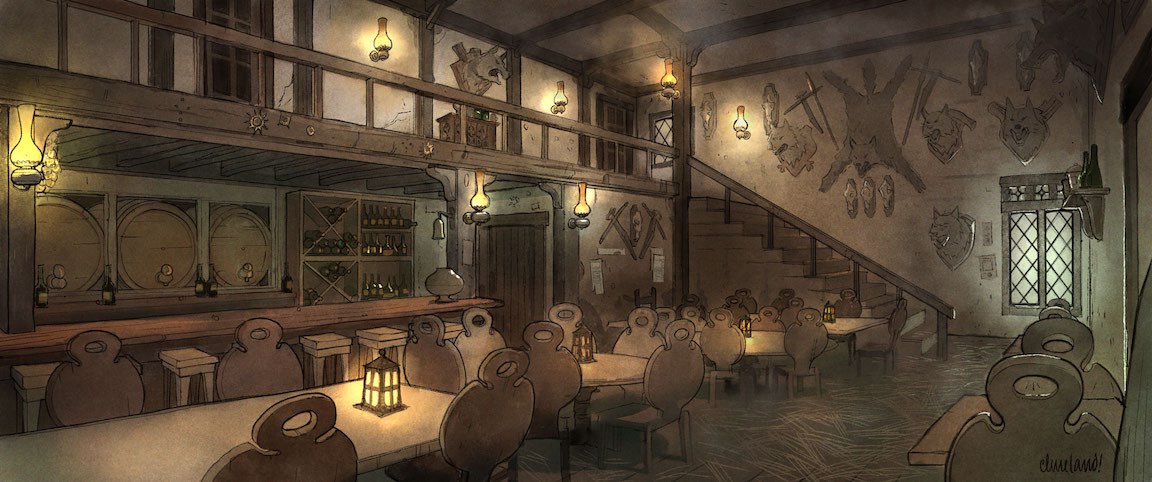 THE BLUE WATER INN TAPROOM
“Welcome back,” he said, setting the broom aside. “I’m afraid we’re closed for the evening. Just to guests.”
“What happened?” Arden asked, though the evidence painted a clear enough picture.
Urwin’s jaw tightened. “Izek Strazni happened. He came looking for your friend—the woman traveling with you. Described her perfectly.” He gestured at the broken furniture, the damaged window. “When Danika and I told him we didn’t know where she was, he tore the place apart looking for her. Ransacked the guest rooms, went through everything.”
The party’s blood ran cold. “Did he find her?” Fig asked urgently.
“No,” Urwin assured them quickly. “She wasn’t here. She’s been staying at the church with Father Lucian. But Izek…” He trailed off, then continued more quietly. “He took some things. Some savings of ours that we’d hidden away. And he made it very clear he’ll be back.”
Urwin offered a wan smile and changed the subject. “Your rooms are cleaned up and ready for you. Danika and I worked through the afternoon to set everything right.”
“We’re sorry,” Choppy said quietly. “That you got caught up in this.”
“Not your fault,” Urwin said firmly. “Izek’s been a menace for years. This just gave him an excuse.” He paused, then added, “If you’re planning to do something about him, I’d advise seeking help. Lady Wachter is known to be his enemy. And Izek is powerful—he travels with guards at nearly all hours. Confronting him openly would be suicide.”
“We’re already working on it,” Varnish said, thinking of the bottle of poisoned wine they’d soon receive.
Urwin nodded, seeming unsurprised. “Good. If you need information about his schedule or his movements, I have… friends. Who might be able to help.”
The party thanked him and turned to leave for the church—they needed to check on Ireena immediately. But as they reached the door, Fig had an idea.
“We should be stealthy about this,” Fig suggested. “No need to lead Izek or his spies straight to her.”
The others agreed, and they set out into the darkened streets of Vallaki with caution. Fig took the lead, moving through shadows and side alleys, but their luck ran out when they quite literally bumped into a town guard making his rounds.
“Halt!” the guard barked, hand going to his sword. “What’s your business out after dark?”
Fig’s mind raced, and they launched into an explanation about heading to the church for evening prayers, embellishing with just enough religious fervor to sound convincing. The guard’s suspicion wavered, then broke.
“Fine,” he grunted. “But mind you don’t cause trouble. And if you see that Ireena woman the Captain’s looking for, you report it. Understand?”
They understood. And they nodded earnestly. And the moment the guard moved on, they doubled their pace toward St. Andral’s Church.
This time, Fig was determined to be stealthy. They circled around to a side window, intending to peek inside to confirm all was safe before entering. What followed was a spectacular failure of grace—Fig tangled themselves in a bush beneath the window, branches snapping with what sounded like thunderous cracks in the quiet night air.
The window sash flew open and Father Lucian’s face appeared, looking startled and then bemused. He peered down at the bush, which rustled pathetically.
“Fig?” he called out, recognizing them. “Is that you in the shrubbery?”
A muffled affirmative came from the bush.
Father Lucian sighed, though his eyes crinkled with suppressed laughter. “Well, you’ve certainly made your presence known. Come around to the door, all of you. Best we speak inside.”
The rest of the party had the decency not to laugh too hard as Fig extracted themselves from the bush, though Varnish’s grin was insufferable.
Inside the church, they found Ireena safe and unaware of Izek’s rampage at the inn. When they told her what had happened—that Izek had ransacked the Blue Water Inn searching for her, that he seemed violently obsessed with finding her—her face went pale, then flushed with anger.
“This is my fault,” she said quietly. “People are suffering because they’re protecting me.”
“No,” Arden said firmly. “This is Izek’s fault. He’s the one choosing violence.”
But that wasn’t all they had to tell her. Fig shared what they’d discovered in the Burgomaster’s library—the record of Ireena Strazni, deceased eighteen years ago, survived by her brother Izek and parents who had subsequently hanged themselves. The same Izek who now commissioned dolls in her exact likeness.
Ireena’s expression shifted through shock, confusion, and finally disgust. “That’s… no. I don’t remember any of that. My father is Kolyan Indirovich. My brother is Ismark. I don’t know what happened eighteen years ago, but whoever that Ireena was, she’s not me. Or if she was…” She shook her head, as if trying to dislodge something. “It doesn’t matter. That life is dead and gone.”
The party explained their plan to kill Izek—they’d already agreed to it with Lady Wachter, and the execution would happen soon. They asked if Ireena had any objections.
Ireena was quiet for a long moment. Then: “I’m not normally one to condone murder. But I’ve heard the stories. The refugees he’s brutalized, the people he’s hurt.” She met their eyes. “I already have a brother, and his name is Ismark. Whoever—whatever—Izek was to me died in that forest years ago. Do what’s necessary to put him down. You have my permission.”
She crossed to a small writing desk in the corner of the church and wrote on a piece of parchment: I, Ireena Kolyana, do hereby endorse the beheading of Izek Strazni. She signed it with a flourish and handed it to them.
Arden stared at the parchment, a slow grin spreading across his face. “This,” he said, “is going on the paper airplane I throw at him before we attack.”
The others laughed despite the grimness of the situation. It was decided: Ireena would stay at the church, safely out of sight, until Izek was dealt with. The party would stay away from the church as well—no need to give Izek any reason to connect the dots.
As they departed St. Andral’s Church, the weight of what was coming settled over them. Tomorrow morning, they would receive poisoned wine and Izek’s schedule from Lady Wachter’s associate. And then they would hunt.
But tonight, they would rest. Tomorrow, the real work began.
Navigation
- Previous Session: Session 13 - The Lost and The Found
- Next Session: Session 15 - Killing Izek